1,830 posters, 67 videos, 75 audios, 29 topics, 22 sessions, 4,727 authors, 1,697 institutions
ePostersLive by SciGen Technologies S.A. All rights reserved.
RCOG World Congress 2023
June 12 - 14, 2023 | London, UK

EP.0645
An Audit at TGH: BURCH COLPOSUSPENSION FOR STRESS URINARY INCONTINENCE IN WOMEN
Poster Presenter
Authors
Affiliations
Part of Topic
Urogynaecology/Pelvic Floor
RCOG ePoster
The Outcome of Burch Colposuspension – An Audit
Tameside & Glossop Integrated Care NHS Foundation Trust, Manchester, United Kingdom
istorical Background
John Christopher Burch was a professor at Vanderbilt University Medical School from 1944 until 1965.
His colposuspension procedure was the result of a frustrating attempt to dissect sufficient periosteum in an elderly woman in whom he was trying to perform an MMK procedure.
Burch improvised and finally performed an attachment at the level of the Cooper ligament.
His original description referred to the operation as a combined incontinence and prolapse repair. The Burch colposuspension has a long‐term success rates in restoring continence of 65-90% over 1-10 years.Over time, Burch colposuspension has been adapted for laparoscopy.
Introduction
Stress incontinence (SUI) causes a significant physical and psychological burden on women.
Owing to recent concerns about synthetic mesh ,the place of colposuspension in clinical practice depends on the data available describing long-term cure results. A number of patients, develop recurrent urinary incontinence after the colposuspension, or other disabling conditions, such as genital prolapse or voiding difficulties.
Objective:
This audit aimed to study short-term and long-term outcomes of open Burch colposuspension at Tameside General Hospital(TGH), and study the subjective and objective impression of cure in our cases of Burch colposuspension.
Study design:
A retrospective audit was conducted at TGH for women with urodynamic stress incontinence (without intrinsic sphincter deficiency) who underwent surgery for stress urinary incontinence.
Methods:
Women included were those who had open Burch colposuspension from January 2019 to Feb 2020, at TGH. Follow-up was by questionnaires and one- time physical or telephone consultation until 5 feb 2023, using a dedicated database.
Primary outcomes were the presence or absence of stress urinary incontinence on follow-up, the success of index surgery based on response to validated questionnaires of patient-reported outcomes, and retreatment rates. The patient's characteristics, operative data and outcome were reviewed. All the data was compiled and analysed on Microsoft Excel 2010®.
Open Burch Technique
A Foley catheter is inserted into the bladder to decompress it and aid in identification of the bladder neck.The incision is either a Pfannenstiel or lower midline abdominal incision to access the retropubic space of Retzius. During the initial dissection, the peritoneal reflection is swept of the bladder. The retropubic space is dissected and the bladder neck, anterior vaginal wall, and urethra are exposed. The bladder neck is identified with palpation of the Foley catheter bulb. The pubocervical fascia may be identified by clearing the periurethral space of overlying fat. To assist in identifying the anterior vaginal wall, an assistant can place a gloved examining finger in the vagina to tent the vagina anteriorly.
Results:
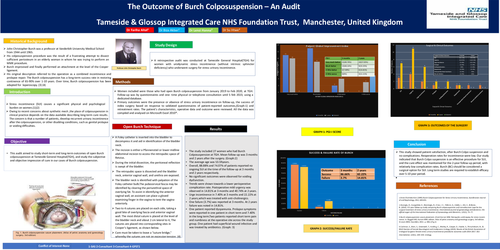
The study included 27 women who had Burch Colpo suspension at TGH. Mean follow-up was 3 months and 2 years after the surgery.
Overall, 88.88% and 74.07% of patients reported no ongoing SUI at the time of the follow-up at 3 months and 2 years respectively. No significant outcomes were observed for voiding dysfunction.
Trends were shown towards a lower perioperative complication rate. Postoperative mild urgency was observed in 14.81% at 3 months and 40.74% at 2 years.
Urge incontinence in 7.40% at 3 months and 22.22% at 2 years,which was treated with anti-cholinergics.
One failure (3.7%) was reported at 3 months. At 2 years failure was noted in 14.81%.
One patient reported dyspareunia. Prolapse symptoms were reported in one patient in short term and 7.40% in the long term.Two patients reported short term pain and numbness at the operative site across the study group. One patient had superficial wound infection and was treated by antibiotics.
Conclusion:
This study showed patient satisfaction, after Burch Colpo suspension and no complications. Reoperation rates for incontinence were low. Our study indicated that Burch Colpo suspension is an effective procedure for SUI, and the cure effect was maintained for the 2-year follow-up period, with relatively low complication rates. Burch should be considered a surgical option for SUI.
Keywords: Burch Colpo suspension, stress urinary incontinence, urgency, follow up
References:
1.Anne-Charlotte Kinn (1995) Burch Colposuspension for Stress Urinary Incontinence, Scandinavian Journal of Urology and Nephrology, 29:4, 449-455.
2.Asıcıoglu, O., Gungorduk, K., Besımoglu, B., Ertas, I. E., Yıldırım, G., Celebı, I., Ark, C., & Boran, B. (2014). A 5-year follow-up study comparing Burch colposuspension and transobturator tape for the surgical treatment of stress urinary incontinence. International journal of gynaecology and obstetrics: the official organ of the International Federation of Gynaecology and Obstetrics, 125(1), 73–77.
3.Burch colposuspension suture placement. (From Karram MM. Retropubic urethropexy for stress inconti- nence. In: Baggish MS, Karram MM, editors. Atlas of pelvic anatomy and gynecology surgery. 3rd edition. St Louis (MO): Saunders; 2011. p. 406.)(Fig,1)
4..Cashman, S., Biers, S., Greenwell, T., Harding, C., Morley, R., Cooper, D., Fowler, S., Thiruchelvam, N., & BAUS Section of Female Neurological and Urodynamic Urology (2019). Results of the British Association of Urological Surgeons female stress urinary incontinence procedures outcomes audit 2014-2017. BJU international, 123(1), 149–159.
5.Miannay, E., Cosson, M., Lanvin, D., Querleu, D., & Crepin, G. (1998). Comparison of open retropubic and laparoscopic colposuspension for treatment of stress urinary incontinence. European journal of obstetrics, gynecology, and reproductive biology, 79(2), 159–166.
6..Ye, Y., Wang, Y., Tian, W., Zhang, Z., Liang, S., Song, X., Guo, J., Gao, Q., Shi, H., Sun, Z., Chen, J., Lang, J., & Zhu, L. (2022). Burch colposuspension for stress urinary incontinence: a 14-year prospective follow-up. Science China. Life sciences, 65(8), 1667–1672.

Professor John Christopher Burch

Fig. 1. Burch colposuspension suture placement. (From Karram MM. Retropubic urethropexy for stress inconti- nence. In: Baggish MS, Karram MM, editors. Atlas of pelvic anatomy and gynecology surgery. 3rd edition. St Louis (MO): Saunders; 2011. p. 406.)

Graph: 1
|
PGI-I |
3 months |
2 years |
|
Very much better |
11(40.74%) |
10(37.03%) |
|
Much better |
13(48.14%) |
9(33.33%) |
|
A little better |
2(7.40%) |
4(14.81%) |
|
A little worse |
0(0%) |
3(11.11%) |

Graph :2
|
Outcome |
3 months |
2 years |
|
Success |
86.66% |
82.22% |
|
Failure |
3.7% |
14.81% |

Graph: 3
|
Surgical & Clinical Outcomes |
3 months |
2 years |
|
SUI |
3(11.11%) |
7(25.92%) |
|
Urgency |
4(14.81%) |
11(40.74%) |
|
Urge incontinence |
2(7.40%) |
6(22.22%) |
|
Prolapse |
1(3.70%) |
2(7.40%) |
|
Voiding dysfunction |
0(0%) |
2(7.40%) |
|
Dyspareunia |
1(3.70%) |
1(3.70%) |
|
Intraoperative blood transfusion |
1(3.70%) |
0(0%) |
|
Wound infection |
1(3.70%) |
0(0%) |