1,830 posters, 67 videos, 75 audios, 29 topics, 22 sessions, 4,727 authors, 1,697 institutions
ePostersLive by SciGen Technologies S.A. All rights reserved.
RCOG World Congress 2023
June 12 - 14, 2023 | London, UK

EP.0584
Seeking consultation for urinary incontinence: behaviours and barriers among Jordanian women
Part of Topic
Urogynaecology/Pelvic Floor
Seeking consultation for urinary incontinence: behaviours and barriers among Jordanian women
Authors: Ismaiel Abu Mahfouz 1 , Marco H. BlanKer3 , Fida Asali 3 , Lama Al Mehaisen 1 , Salem Abu Mahfouz 3 Samaa Siyam 1, Mays Al Attar 1
1- The Specialty Hospital 2- Al-Balqa Applied University 3-University of Groningen 4-The Hashemite University
- Introduction
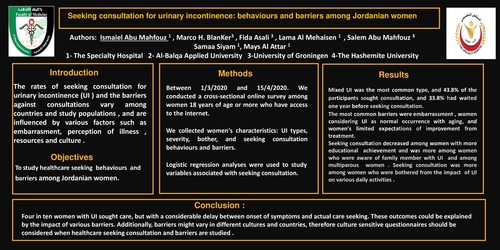
The rates of seeking consultation for urinary incontinence (UI ) and the barriers against consultations vary among countries and study populations , and are influenced by various factors such as embarrasment, perception of illness , resources and culture .
- Objectives
To study healthcare seeking behaviours and
barriers among Jordanian women.
- Methods
Between 1/3/2020 and 15/4/2020. We conducted a cross-sectional online survey among women 18 years of age or more who have access to the internet.
We collected women's characteristics: UI types, severity, bother, and seeking consultation behaviours and barriers.
Logistic regression analyses were used to study variables associated with seeking consultation.
- Results
Mixed UI was the most common type, and 43.8% of the participants sought consultation, and 33.8% had waited one year before seeking consultation.
The most common barriers were embarrassment , women considering UI as normal occurrence with aging, and women's limited expectations of improvement from treatment.
Seeking consultation decreased among women with more educational achievement and was more among women who were aware of family member with UI and among multiparous women . Seeking consultation was more among women who were bothered from the impact of UI on various daily activities .
- Conclusion
Four in ten women with UI sought care, but with a considerable delay between onset of symptoms and actual care seeking. These outcomes could be explained by the impact of various barriers. Additionally, barriers might vary in different cultures and countries, therefore culture sensitive questionnaires should be considered when healthcare seeking consultation and barriers are studied .