1,830 posters, 67 videos, 75 audios, 29 topics, 22 sessions, 4,727 authors, 1,697 institutions
ePostersLive by SciGen Technologies S.A. All rights reserved.
RCOG World Congress 2023
June 12 - 14, 2023 | London, UK

EP.0576
Gynaecologic robotic (da Vinci) surgery; cohort study of 100 cases in Greece.
Poster Presenter
Authors
Elias Tsakos, Emmanouil Xydias, Kanelina Bimba, Apostolos C. Ziogas, Stergios Doumouchtsis, Nikolaos Vlachos
Affiliations
Chair, Hellenic IRC, RCOG, EmbryoClinic IVF, University of Thessaly, School of Health Sciences, Faculty of Medicine, National and Kapodistrial University of Athens, School of Medicine, Department of Obstetrics and Gynaecology, Epsom & St. Helier University Hospitals
Part of Topic
Innovation
Gynaecologic robotic (da Vinci) surgery; cohort study of 100 cases in Greece.
Introduction
Robotic surgery has been a rapidly developing field in recent years, particularly as far as Gynaecological Surgery is concerned. The robotic equipment was designed to surpass the limitation of conventional laparoscopy, providing superior, three-dimensional visualization of the surgical site, increased magnification of areas of interest, enhanced dexterity via highly articulating surgical instruments and absent tremor. Additionally, the ergonomic working configuration of the console ensures reduced strain, be it physical or mental, to the surgeon, with significant improvement to surgery ergonomics, a vital feature especially for high-volume surgeons and/or multi-hour procedures.
Since the introduction of Robotic Gynaecological Surgery in Greece, public interest on the new technique has been growing slowly, as the increased cost has impacted its spread, with the vast majority of Robotic Gynaecological Surgeons practicing in the private sector. In this retrospective study, we present our experience with the first 100 cases that underwent robotic surgery by a single, experienced surgeon (E.T.).
Methods & Materials
This is a retrospective case series including the first 100 patients treated using robotic-assisted surgery by our team. All patients operated on from January 1st, to May 20th 2023 were included. All procedures were conducted in St. Luke’s Hospital, located in Thessaloniki, Greece. All procedures were conducted by the same, trained and certified lead Console Surgeon (E.T.), using the Da Vinci X Surgical System. All procedures were conducted using a multi-port approach, with 3 to 4 robotic ports (8mm) for surgical instruments and the camera and one accessory port (10-12mm) for the assistant surgeon. Data was collected based on the hospital files and analyzed using the SPSS Statistical Processing Software.
Patients were contacted and asked to provide consent for participating in the study. The study protocol was approved by the IRB of St. Luke’s Hospital.
Results
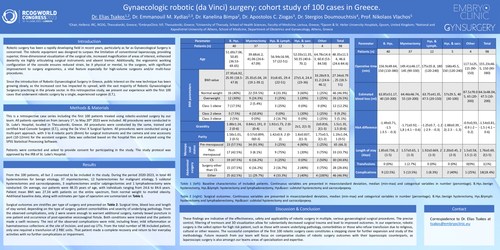
From the 100 patients, all but 2 consented to be included in the study. During the period 2020-2023, in total 40 hysterectomies for benign etiology, 37 myomectomies, 12 hysterectomies for malignant etiology, 5 subtotal hysterectomies and sacrocolpopexies, 3 oophorectomies and/or salpingectomies and 1 lymphadenectomy were conducted. On average, our patients were 48.35 years of age, with individuals ranging from 24.6 to 84.6 years. Patient mean BMI was 27.34 with patients on the entire spectrum, from normal weight to morbid obesity. Additional baseline data, along with estimates per type of operation are summarized on Table 1.
Surgical outcomes are stratifies per type of surgery and presented on Table 2. Surgical time, blood loss and length of stay varied, depending on the type of surgery, patient comorbidities and severity of underlying pathology. From the observed complications, only 2 were severe enough to warrant additional surgery, namely bowel puncture in one patient and occurrence of post-operative vesicovaginal fistula. Both conditions were treated and the patients made a swift recovery. The rest of the observed complications were mild, including fever, mild inflammation or haematoserous collections at the site of incision, and post-op UTIs. From the total number of 98 included patient, only one required a transfusion of 2 RBC units. That patient made a complete recovery and return to her everyday activities with no further complications or impairment.
Discussion & Conclusion
These findings are indicative of the effectiveness, safety and applicability of robotic surgery in multiple, various gynaecological surgical procedures. The precise control, filtering of tremours and 3D visualization allow for substantially decreased surgical trauma and lead to improved outcomes. In our experience, robotic surgery is the safest option for high risk patient, such as those with severe underlying pathology, comorbidities or those who refuse transfusion due to religious, cultural or other reasons. The successful completion of the first 100 robotic surgery cases constitutes a stepping stone for further expansion and study of the methodology. Future research from our team will focus on comparative studies of robotic surgery outcomes with their laparoscopic counterparts, as laparoscopic surgery is also amongst our teams areas of specialization and expertise.
Contact
Correspodence to Dr. Elias Tsakos at tsakos@embryoclinic.eu