1,830 posters, 67 videos, 75 audios, 29 topics, 22 sessions, 4,727 authors, 1,697 institutions
ePostersLive by SciGen Technologies S.A. All rights reserved.
RCOG World Congress 2023
June 12 - 14, 2023 | London, UK

EP.0568
Implementation of new NICE guidance on progesterone use in early pregnancy
Poster Presenter
Part of Topic
Early Pregnancy Complications and Gynaecology
Implementation of New NICE Guidance on Progesterone Use in Early Pregnancy: Ongoing Audit
A Whitehead & M Baumgarten – Cambridge University Hospitals NHS Trust
Background
In November 2021, the National Institute for Health and Care Excellence (NICE) recommended that progesterone should be offered to women who experience bleeding in early pregnancy and have previously had a miscarriage.[1] Following literature review and NICE guidelines, our unit decided to offer all women with vaginal bleeding and at least one previous pregnancy loss an ultrasound assessment if gestational age from last menstrual period was > 6 weeks. If earlier, patients were asked to observe for at least one week. When viable intrauterine pregnancy measuring 6+0 to 8+6 was confirmed, counselling regarding the option of using progesterone was carried out.
The aim of the audit was to evaluate the impact on scan capacity and compare pregnancy outcomes to available data.
Methods
An ongoing prospective audit was started in November 2021. All women with bleeding in early pregnancy were reviewed for eligibility and the details entered into a purpose-designed database.
Results
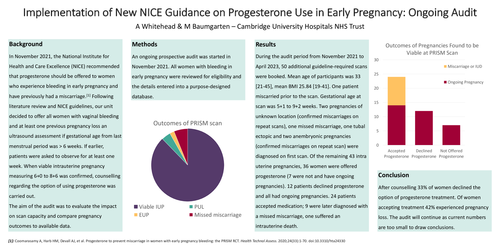
During the audit period from November 2021 to April 2023, 50 additional guideline-required scans were booked. Mean age of participants was 33 [21-45], mean BMI 25.84 [19-41]. One patient miscarried prior to the scan. Gestational age at scan was 5+1 to 9+2 weeks. Two pregnancies of unknown location (confirmed miscarriages on repeat scans), one missed miscarriage, one tubal ectopic and two anembryonic pregnancies (confirmed miscarriages on repeat scan) were diagnosed on first scan. Of the remaining 43 intra uterine pregnancies, 36 women were offered progesterone (7 were not and have ongoing pregnancies). 12 patients declined progesterone and all had ongoing pregnancies. 24 patients accepted medication; 9 were later diagnosed with a missed miscarriage, one suffered an intrauterine death.
Conclusion
After counselling 33% of women declined the option of progesterone treatment. Of women accepting treatment 42% experienced pregnancy loss. The audit will continue as current numbers are too small to draw conclusions.
[1]: Coomarasamy A, Harb HM, Devall AJ, et al. Progesterone to prevent miscarriage in women with early pregnancy bleeding: the PRISM RCT. Health Technol Assess. 2020;24(33):1-70. doi:10.3310/hta24330