Loading...

1,830 posters, 67 videos, 75 audios, 29 topics, 22 sessions, 4,727 authors, 1,697 institutions

ePostersLive by SciGen Technologies S.A. All rights reserved.

RCOG World Congress 2023

June 12 - 14, 2023 | London, UK

RCOG World Congress 2023 banner

EP.0513

Outcomes of Restorelle® DirectFix Anterior Mesh in Pelvic Organ Prolapse
Part of Topic

Urogynaecology/Pelvic Floor

Outcomes of Restorelle® DirectFix Anterior Mesh in Pelvic Organ Prolapse

Yi Man Goh1, Hong Liang Chua2, How Chuan Han3, Jill Cheng Sim Lee2

1.Yong Loo Lin School of Medicine, Singapore
2.Department of Urogynaecology, KK Women’s and Children’s Hospital, Singapore
3.Mount Elizabeth Novena Hospital, Singapore
 

Introduction

•The use of transvaginal mesh surgery (TVM) in pelvic organ prolapse has resulted in lower prolapse recurrence than native tissue repair (NTR).
•However, insufficient safety and efficacy evidence led to the FDA withdrawal of TVMs in 2019. 

The RestorelleDirectFix Anterior Mesh is a 4-arm, ultra-lightweight (19g/m2), type 1 polypropylene mesh for transvaginal anterior compartment repairs. 

Aims

To determine the efficacy and long-term outcomes for the transvaginal RestorelleDirectFix Anterior Mesh in patients with severe pelvic organ prolapse (POP).


Methods

•This case series study was conducted in patients with severe pelvic organ prolapse who underwent Restorelle® TVM between 1 July 2017 and 30 September 2018 in KK Women’s and Children’s Hospital.
•The first 30 patients treated with the Reastorelle ® mesh were excluded from this study as part of the learning curve.
•Clinical characteristics and outcomes were identified through review of case notes, until 3 years post-operatively
•Primary outcome was defined as a patient with post-operative Baden-Walker Grade 1 or less cystocele while the secondary outcome was to assess for mesh-related complications.
 

Results

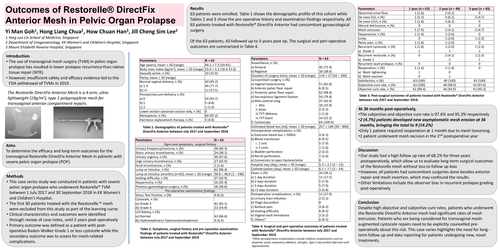
63 patients were enrolled. Table 1 shows the demographic profile of this cohort while Tables 2 and 3 show the pre-operative history and examination findings respectively. All 63 patients treated with Restorelle® DirectFix Anterior had concomitant gynaecological surgery.


Of the 63 patients, 43 followed up to 3-years post op. The surgical and peri-operative outcomes are summarized in Table 4.


At 36 months post-operatively,

•The subjective and objective cure rate is 97.6% and 95.3% respectively
•2 (4.7%) patients developed new asymptomatic mesh erosion at 36 months, bringing the total to 9 (14.2%)
•Only 1 patient required reoperation at 1 month due to mesh loosening.
•1 patient underwent mesh excision in the 2nd postoperative year


Discussion

•Our study had a high follow up rate of 68.2% for three years postoperatively, which allow us to evaluate long-term surgical outcomes of the Restorelle mesh without loss to follow up bias
•However, all patients had concomitant surgeries done besides anterior repair and mesh insertion, which may confound the results.
•Other limitations include the observer bias in recurrent prolapse grading post-operatively 


Conclusion

Despite high objective and subjective cure rates, patients who underwent the Restorelle DirectFix Anterior mesh had significant rates of mesh extrusion. Patients who are being considered for transvaginal mesh-augmented cystocele repairs need to be explicitly counselled pre-operatively about this risk. This case series highlights the need for long-term follow up and data reporting for patients undergoing new, novel treatments. 


RCOG World Congress 2023 » banner
Copyright © 2015-2026, ePostersLive® SciGen is a registered trademark of SciGen Technologies S.A. Patent pending.

This website and third-party tools we use rely on cookies for the best user experience. By selecting "I agree", you agree to cookie usage as described in our Privacy Policy.