1,830 posters, 67 videos, 75 audios, 29 topics, 22 sessions, 4,727 authors, 1,697 institutions
ePostersLive by SciGen Technologies S.A. All rights reserved.
RCOG World Congress 2023
June 12 - 14, 2023 | London, UK

EP.0479
The association between miscarriage, migraine and exposure to triptans in pregnancy
Poster Presenter
Part of Topic
Early Pregnancy Complications and Gynaecology
The association miscarriage with migraine and exposure to triptans in pregnancy: a matched cohort and nested case control study.
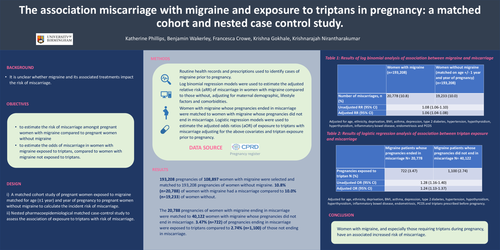
i) A matched cohort study of pregnant women exposed to migraine matched for age (±1 year) and year of pregnancy to pregnant women without migraine to calculate the incident risk of miscarriage.
Routine health records and prescriptions used to identify cases of migraine prior to pregnancy.
Log binomial regression models were used to estimate the adjusted relative risk (aRR) of miscarriage in women with migraine compared to those without, adjusting for maternal demographic, lifestyle factors and comorbidities.
Women with migraine whose pregnancies ended in miscarriage were matched to women with migraine whose pregnancies did not end in miscarriage. Logistic regression models were used to estimate the adjusted odds ratios (aOR) of exposure to triptans with miscarriage adjusting for the above covariates and triptan exposure prior to pregnancy.
193,208 pregnancies of 108,897 women with migraine were selected and matched to 193,208 pregnancies of women without migraine. 10.8% (n=20,788) of women with migraine had a miscarriage compared to 10.0% (n=19,233) of women without.
The 20,788 pregnancies of women with migraine ending in miscarriage were matched to 40,122 women with migraine whose pregnancies did not end in miscarriage. 3.47% (n=722) of pregnancies ending in miscarriage were exposed to triptans compared to 2.74% (n=1,100) of those not ending in miscarriage.
Women with migraine, and especially those requiring triptans during pregnancy, have an associated increased risk of miscarriage.