1,830 posters, 67 videos, 75 audios, 29 topics, 22 sessions, 4,727 authors, 1,697 institutions
ePostersLive by SciGen Technologies S.A. All rights reserved.
RCOG World Congress 2023
June 12 - 14, 2023 | London, UK

EP.0435
Estimating fetal weight: are we getting it right?
Poster Presenter
Authors
Affiliations
Part of Topic
Imaging in Obstetrics
Estimated Fetal Weight: are we gettingit right?
Auditing ultrasound based estimations of fetal weight and comparing these to measured birth weights to assess sonograaphic estimations of fetal weight.
Authors
Thomas Hanton, Robin Hughes
Affiliations
York and Scarborough Teaching Hospitals NHSfoundation Trust, York Hospital, WiggintonRoad, Clifton, York, YO31 8HE, United Kingdom
Background
Accurately estimating fetal weight (EFW) forms acornerstone of modern obstetric practice in helpingdetermine management plans relating to the modeand timing of delivery. This audit seeks to assesscurrent routine practice at York and ScarboroughTeaching Hospitals in objective terms.
The standards chosen were those observed by Francis,Tonks and Gardosi (2011) in their reveiw of EFWaccuracy
Standards
>= 96% EFW within 20%of BW
>= 90% EFW within 15%of BW
>= 73% EFW within 10%of BW
Methods
Comparison between hospital sites
Ultrasound within three days of delivery
Maternal BMI
All obstetric growth scans performed from 24+0 weeks of gestation at York and Scarborough Teaching Hospitals (across five hospital sites: York Hospital, Selby War Memorial Hospital, Scarborough Hospital, BridlingtonHospital, and Malton Community Hospital) in January 2022 were reviewed. Further growth scans within the same pregnancy were also reviewed. All cases where delivery occurred within 14 days of examination wereincluded. Only cases without available data (i.e. delivering elsewhere) were excluded. The birthweight (BW) was identified and error margin calculated using the Perinatal Institute's EFW Audit Tool which adjusts for theinterval between examination and delivery (adjusted EFW or EFWa). In addition to an overall analysis, sub-analyses were performed across the following:
1.
2.
3.
727 Scans were reviewed, comprising 620 patients, of which 304 delivered within two weeks and had data available.
EFW was calculated using the Hadlock-formula, calculated automatically by software on the department's scanners. Of the 304 scans analysed, 289 had EFW calculated with Abdominal Circumference (AC), FemurLength (FL) and Head Circumference (HC) and 15 had EFW calculated with AC and FL only.
Analysis
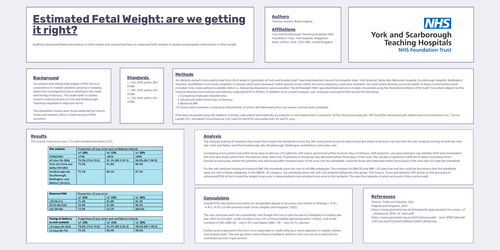
The analysis looking at hospital sites found that overall the standards across the 304 scans done across all sites across the whole trust were met and that the sub-analysis looking at both the Yorksite (York and Selby) and the Scarborough site (Scarborough, Bridlington and Malton) were also met.
Comparing scans performed within three days of delivery (74 patients) with scans
performed within fourteen days of delivery (304 patients), we were looking to see whether EFW error increased ifthe scan was done further from the delivery date. With only 74 patients in the group who delivered within three days of the scan, the number of patients is difficult to draw conclusions from.Overall as previously stated the patients who delivered within fourteen days of the scan met the standards, however those who delivered within three days of the scan did not meet the standards.
For the sub-analysis looking at maternal BMI, the standards were not met for all BMI categories. The numbers for BMI<20 and BMI>=35 were low and this could be the reason that the standardswere not met in these categories. In the BMI20-35 category, the standards were met with 236 patients falling into this group. The Francis, Tonks and Gardosi 1997 poster on the accuracy ofultrasound EFW at term found the largest scan error in obese patients and smallest scan error in thin patients. This was the opposite of what we found in this smaller audit.
References
Francis, Tonks and Gardosi, 2011
Hughes and Ferguson, 2021
https://www.perinatal.org.uk/fetalgrowth/gap/sendout/Accuracy_of_ultrasound_EFW_at_term.pdf
https://www.perinatal.org.uk/GAP/Ultrasound#:~:text=EFW%20Audit%20Tool,scan%20and%20date%20of%20delivery.
Conculsions
Overall EFW calculations are within an acceptable degree of accuracy and similar to findings (-0.4%,-4.4%, +0.5%) of the previous audit cycle (Hughes and Ferguson, 2021).
The sub-analyses were not consistently met though this may in part be due to a disparity in hospital sitesize (40% at one site), small numbers (only 19% of those eligible delivering within 3 days), and smallnumbers of thin (BMI<20 - only 6.9%) and obese (BMI>=35 - only 15.1%) women .
Further work is planned in the form of an expanded re-audit utilising a novel approach to rapidly collateand analyse data. This will generate more effective feedback which in turn may act as a substrate forcontinued cyclical improvement.