1,830 posters, 67 videos, 75 audios, 29 topics, 22 sessions, 4,727 authors, 1,697 institutions
ePostersLive by SciGen Technologies S.A. All rights reserved.
RCOG World Congress 2023
June 12 - 14, 2023 | London, UK

EP.0126
“Does my baby look big in this?” Scan accuracy in suspected macrosomia.
Poster Presenter
Authors
Affiliations
Part of Topic
Imaging in Obstetrics
“Does my baby look big in this?” Scan accuracy in suspected macrosomia.
Ellie Bard, Edwin Ruhinda, Deepa Janga
Objective
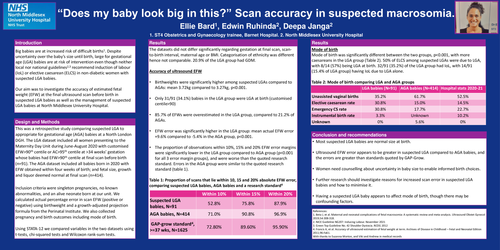
To investigate the accuracy of estimated fetal weight (EFW) on ultrasound scan in suspected large (LGA) babies.
Design
A retrospective study comparing suspected LGA to appropriate for gestational age (AGA) babies at a North London DGH.
Methods
The LGA dataset included all women presenting to the Maternity Day Unit during June-August 2020 with customised EFW>90th centile or AC>95th centile at >34 weeks’ gestation whose babies had EFW>90th centile at final scan before birth (n=91).
The AGA dataset included all babies born in 2020 with EFW obtained within four weeks of birth; and fetal size, growth and liquor deemed normal at final scan (n=414).
Inclusion criteria were singleton pregnancies, no known abnormalities, and an alive neonate born at our unit. We calculated actual percentage scan error (positive or negative) using birthweight and a growth-adjusted projection formula from the Perinatal Institute. Absolute error refers to the magnitude of percentage scan error (positive).
Using STATA-12 we compared variables in the two datasets with t-tests, chi-squared tests and Wilcoxon rank-sum tests.
Results
The datasets did not differ significantly regarding gestation at final scan, scan-to-birth interval, maternal age or BMI. Categorisation of ethnicity was different hence not comparable. Birthweights were significantly higher among suspected LGAs: mean 3.72kg compared to 3.27kg, p<0.001. 31/91 (34.1%) babies in the LGA group were LGA at birth (customised centile>90) and 85.7% of EFWs were overestimated, compared to 21.2% of AGAs. EFW error was significantly higher in the LGA group: mean actual error 9.6% compared to -5.4%, p=0.029; median absolute error 9.7% compared to 6.8%, p<0.001. The proportion of observations within 5%, 10%, 15% and 20% absolute error margins were significantly lower in the LGA group: 28.6%, 52.8%, 75.8% and 87.9% compared to 34.8%, 71%, 90.8% and 96.9% in the AGA group, with p-values <0.05 when comparing 10%, 15% and 20% error margins.
Mode of birth was significantly different between the two groups: 35% vaginal and 61.6% caesarean among LGAs compared to 61.7% vaginal and 32.7% caesarean among AGAs, p<0.001. 50% of elective caesareans among suspected LGAs were due to LGA, with 8/14 (57%) of these being LGA at birth and 1/14 (7%) >4.5kg.
Conclusion
Most suspected LGA babies are normal size at birth. EFW error was greater in suspected LGA compared to AGA babies. Women need counselling about the uncertainty in EFW to enable informed birth choices. Further research should investigate reasons for increased scan error and ways to minimise it.