1,830 posters, 67 videos, 75 audios, 29 topics, 22 sessions, 4,727 authors, 1,697 institutions
ePostersLive by SciGen Technologies S.A. All rights reserved.
RCOG World Congress 2023
June 12 - 14, 2023 | London, UK

EP.0415
Rare Case of Cornual Ectopic Pregnancy:
Poster Presenter
Authors
Affiliations
Part of Topic
Early Pregnancy Complications and Gynaecology
Rare Case of Cornual Ectopic Pregnancy:
Objective:
To raise the awareness about cornual ectopic given the rarity but a potentially life threatening nature of the condition.
Case Report:
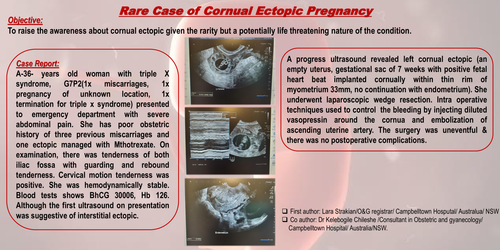
A-36- years old woman with triple X syndrome, G7P2(1x miscarriages, 1x pregnancy of unknown location, 1x termination for triple x syndrome) presented to emergency department with severe abdominal pain. She has poor obstetric history of three previous miscarriages and one ectopic managed with Mthotrexate. On examination, there was tenderness of both iliac fossa with guarding and rebound tenderness. Cervical motion tenderness was positive. She was hemodynamically stable. Blood tests showed BhCG 30006, Hb 126. Although the first ultrasound on presentation was suggestive of interstitial ectopic. A progress ultrasound revealed left cornual ectopic (an empty uterus, gestational sac of 7 weeks with positive fetal heart beat implanted cornually within thin rim of myometrium 33mm, no continuation with endometrium). She underwent laparoscopic wedge resection. Intra operative techniques used to control the bleeding by injecting diluted vasopressin around the cornua and embolization of ascending uterine artery. The surgery was uneventful & there was no postoperative complications.
Discussion
Cornual ectopic accounts for 2% of all ectopic pregnancies. It refers to a pregnancy implanted medial to utero tubal junction close to the proximal ostrium of fallopian tube. Because of the difficulty to accurately diagnose cornual ectopic in early gestation, it presents as rupture ectopics in 20-50% of cases especially in advance gestation with a reported rate of maternal mortality of 2-2.5%. There is increasing incidence of cornual ectopic in parallel with the increasing rate of PID, IUD use. Ipsilateral salpingectomy has been reported as a specific risk factor for Cornual ectopic. Transvaginal ultrasound is essential for the diagnosis of ectopic pregnancy. In cases where US is inconclusive, MRI could be another useful modality to aid in the diagnoses. Management options includes medical, surgical and expectant. Systemic and intra sac injection of Methotrexate is applicable in women who are hemodynamically stable and meet the selection criteria. Surgical management includes laproscopic cornual resection and or salpingotomy. Intra op techniques have been described to minimize the risk of bleeding such as vasopressin injections. The woman should be counselled about risk of uterine rapture in the future pregnancies regardless of the treatment option. Laparotomy with Hysterectomy is indicated if signs of rapture with hemoperitoneum are present.
Conclusion:
Cornual ectopic is rare but potentially life threatening condition. High index of suspicion is required for early diagnosis and to prevent catastrophic complications.