1,830 posters, 67 videos, 75 audios, 29 topics, 22 sessions, 4,727 authors, 1,697 institutions
ePostersLive by SciGen Technologies S.A. All rights reserved.
RCOG World Congress 2023
June 12 - 14, 2023 | London, UK

EP.0408
Spontaneous tubal stump pregnancy after laparoscopic unilateral salpingectomy
Poster Presenter
Authors
Affiliations
Part of Topic
Early Pregnancy Complications and Gynaecology
Audio
Objective
Tubal stump pregnancy is a rare form of ectopic pregnancy, and typically not the first differential diagnosis a gynaecologist considers when facing a pregnancy of unknown location. A delay in diagnosis can lead to catastrophic consequences for the patient from rupture causing haemodynamic shock.
Case report
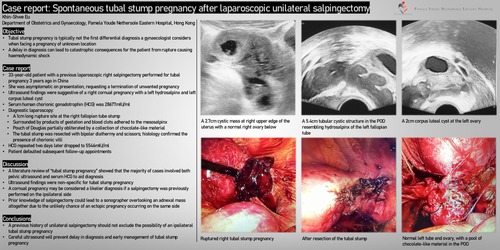
A 33-year-old patient with a previous laparoscopic right salpingectomy performed for tubal pregnancy initially presented requesting termination of an unplanned pregnancy. Transvaginal ultrasound showed a 2.7cm right adnexal mass near the upper edge of the uterus and another 5cm tubular cystic structure in the pouch of Douglas (POD). Serum human chorionic gonadotrophin (HCG) was 28677mIU/ml.Suspecting cornual pregnancy, she underwent diagnostic laparoscopy.A 1cm long rupture site was seen at the right fallopian tube stump, surrounded by products of gestation and blood clots adhered to the mesosalpinx; the contralateral tube was normal. The POD was partially obliterated by a collection of chocolate-like material. The tubal stump was resected with bipolar diathermy and scissors and sent for histological examination, which confirmed the presence of chorionic villi. HCG repeated two days later dropped to 5546mIU/ml. The patient defaulted subsequent appointments after discharge from in-patient care.
Discussion
A literature review with the keywords “tubal stump pregnancy” showed that the majority of cases involved bothpelvic ultrasound and serum HCG to aid diagnosis of ectopic pregnancy. However, ultrasound findings were generally non-specific for tubal stump pregnancy and diagnosis was sometimes confirmed only after direct visualisation during operation. In the context of a previous salpingectomy, a cornual pregnancy may be considered a likelier diagnosis if an adnexal mass is seen on the ipsilateral side, as was the case for our patient.In fact, prior knowledge of tubal surgery could possibly lead to a sonographer overlooking an adnexal massaltogether due to the unlikely chance of an ectopic pregnancy occurring on the same side.
Conclusions
A previous history of unilateral salpingectomy should not exclude the possibility of an ipsilateral tubal stump pregnancy. Careful ultrasound will prevent delay in diagnosis and early management of tubal stump pregnancy.