1,830 posters, 67 videos, 75 audios, 29 topics, 22 sessions, 4,727 authors, 1,697 institutions
ePostersLive by SciGen Technologies S.A. All rights reserved.
RCOG World Congress 2023
June 12 - 14, 2023 | London, UK

EP.0361
Placental site nodule – a case report and literature review
Poster Presenter
Authors
Affiliations
Part of Topic
Early Pregnancy Complications and Gynaecology
Placental Site Nodule – Case Report and Literature Review
Objective
We report a rare placental site nodule (PSN) in a nulliparous 35-year-old woman with recurrent miscarriages, and no other risk factors for infertility.
Case Report
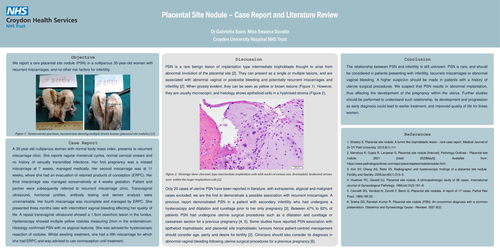
A 35-year-old nulliparous woman with normal body mass index, presents to recurrent miscarriage clinic. She reports regular menstrual cycles, normal cervical smears and no history of sexually transmitted infections. Her first pregnancy was a missed miscarriage at 7 weeks, managed medically. Her second miscarriage was at 11 weeks, where she had an evacuation of retained products of conception (ERPC). Her third miscarriage was managed conservatively at 4 weeks gestation. Patient and partner were subsequently referred to recurrent miscarriage clinic. Transvaginal ultrasound, hormonal profiles, antibody testing and semen analysis were unremarkable. Her fourth miscarriage was incomplete and managed by ERPC. She presented three months later with intermittent vaginal bleeding affecting her quality of life. A repeat transvaginal ultrasound showed a 1.5cm isoechoic lesion in the fundus. Hysteroscopy showed multiple yellow nodules measuring 2mm in the endometrium. Histology confirmed PSN with no atypical features. She was advised for hysteroscopic resection of nodules. Whilst awaiting treatment, she had a fifth miscarriage for which she had ERPC and was advised to use contraception until treatment.
Discussion
PSN is a rare benign lesion of implantation type intermediate trophoblasts thought to arise from abnormal involution of the placental site [2]. They can present as a single or multiple lesions, and are associated with abnormal vaginal or postcoital bleeding and potentially recurrent miscarriages and infertility [2]. When grossly evident, they can be seen as yellow or brown lesions (Figure 1). However, they are usually microscopic; and histology shows epithelioid cells in a hyalinised stroma (Figure 2). Only 20 cases of uterine PSN have been reported in literature, with extrauterine, atypical and malignant cases excluded; we are the first to demonstrate a possible association with recurrent miscarriages. A previous report demonstrated PSN in a patient with secondary infertility who had undergone a hysteroscopy and dilatation and curettage prior to her only pregnancy [3]. Between 47% to 82% of patients PSN had undergone uterine surgical procedures such as a dilatation and curettage or caesarean section for a previous pregnancy [4, 5]. Some studies have reported PSN association with epitheloid trophoblastic and placental site trophoblastic tumours hence patient-centred management should consider age, parity and desire for fertility [2]. Clinicians should also consider its diagnosis in abnormal vaginal bleeding following uterine surgical procedures for a previous pregnancy [6].
Conclusion
The relationship between PSN and infertility is still unknown. PSN is rare, and should be considered in patients presenting with infertility, recurrent miscarriages or abnormal vaginal bleeding. A higher suspicion should be made in patients with a history of uterine surgical procedures. We suspect that PSN results in abnormal implantation, thus affecting the development of the pregnancy within the uterus. Further studies should be performed to understand such relationship, its development and progression as early diagnosis could lead to earlier treatment, and improved quality of life for these women.
References
1. Shastry S. Placental site nodule: A tumor like trophoblastic lesion - rare case report. Medical Journal of Dr DY Patil University. 2015;8(1):111.
2. Mendoza R, Gupta R, Lanjewar S. Placental site nodule [Internet]. Pathology Outlines - Placental site nodule. 2021 [cited 2023May5]. Available from: https://www.pathologyoutlines.com/topic/placentaplacentalsitenodule.html.
3. Kim SY, Chang AS, Ratts VS. Radiographic and hysteroscopic findings of a placental site nodule. Fertility and Sterility. 2005Jan;83(1):213–5.
4. Huettner PC, Gersell DJ. Placental site nodule: A clinicopathologic study of 38 cases. International Journal of Gynecological Pathology. 1994Jul;13(3):191–8.
5. Carinelli SG, Vendola N, Zanotti F, Benzi G. Placental site nodules. A report of 17 cases. Pathol Res Pract. 1989;185:30.
6. Sneha GS, Ramesh Kumar R. Placental site nodule (PSN): An uncommon diagnosis with a common presentation. Obstetrics and Gynaecology Cases - Reviews. 2021;8(2).