1,830 posters, 67 videos, 75 audios, 29 topics, 22 sessions, 4,727 authors, 1,697 institutions
ePostersLive by SciGen Technologies S.A. All rights reserved.
RCOG World Congress 2023
June 12 - 14, 2023 | London, UK

EP.0342
Interstitial Pregnancies; A Case Series
Poster Presenter
Authors
Affiliations
Part of Topic
Early Pregnancy Complications and Gynaecology
Audio
Interstitial Pregnancies: a Case Series
Dr Amy Daglish (St2 Obstetrics and Gynaecology, North West London)
Miss Anjali Sharma (Consultant Obstetrics and Gynaecology, West Middlesex Hospital)
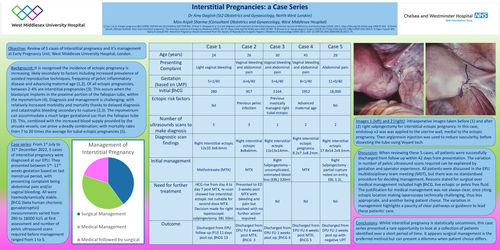
Objective; Review of 5 cases of Interstitial pregnancy and it’s management at Early Pregnancy Unit, West Middlesex University Hospital, London.
Background; It is recognised the incidence of ectopic pregnancy is increasing; likely secondary to factors including increased prevalence of assisted reproductive techniques, frequency of pelvic inflammatory disease and advancing maternal age (1,2). Of all ectopic pregnancies, between 2-4% are interstitial pregnancies (3). This occurs when the blastocyst implants in the proximal portion of the fallopian tube, within the myometrium (4). Diagnosis and management is challenging; with relatively increased morbidity and mortality thanks to delayed diagnosis and catastrophic bleeding secondary to rupture (2,3). The myometrium can accommodate a much larger gestational sac than the fallopian tube (3). This, combined with the increased blood supply provided by the arcuate vessels, can prove a deadly combination; with mortality rates from 7 to 20 times the average for tubal ectopic pregnancies (5).
Case series: From 1st July to 31st December 2022, 5 cases of interstitial pregnancy were diagnosed at our EPU. They presented between 5th- 11th weeks gestation based on last menstrual period, with presenting complaint being abdominal pain and/or vaginal bleeding. All were haemodynamically stable. βhCG (beta human chorionic gonadotrophin) measurements varied from 280 to 5164 IU/L at first assessment and number of pelvic ultrasound scans required before management ranged from 1 to 5.
Images 1 (left) and 2 (right): intraoperative images taken before (1) and after (2) right salpingectomy for interstitial ectopic pregnancy. In this case, endoloop x3 was was applied to the uterine wall, medial to the ectopic pregnancy. Then argipressin injection was used to reduce vascularity, before dissecting the tube using Voyant tech.
Discussion: When reviewing these 5 cases, all patients were successfully discharged from follow up within 42 days from presentation. The variation in number of pelvic ultrasound scans required can be explained by gestation and operator experience. All patients were discussed in the EPU multidisciplinary team meeting (MDT), but there was no standardised procedure for deciding management. Reasons stated for surgical over medical management included high βhCG, live ectopic or pelvic free fluid. The justification for medical management was not always clear, once citing ectopic location making laparoscopy technically challenging, thus less appropriate, and another being patient choice. The variation in management highlights a paucity of clear pathways or guidance to lead these patients’ care.
Conclusions: Whilst interstitial pregnancy is statistically uncommon, this case series presented a rare opportunity to look at a collection of patients identified over a short period of time. It appears surgical management is the preferred method but can present a dilemma when patient choice differs.