1,830 posters, 67 videos, 75 audios, 29 topics, 22 sessions, 4,727 authors, 1,697 institutions
ePostersLive by SciGen Technologies S.A. All rights reserved.
RCOG World Congress 2023
June 12 - 14, 2023 | London, UK

EP.0285
Establishing a multi-disciplinary Birth Choices Clinic (BCC)– Outcomes and experi
Poster Presenter
Authors
Geetanjali Sharma, Meena Bhatia, Apoorva Asranna, Sophie McAllister, Claire Litchfield, Katja Shipp
Affiliations
Part of Topic
Innovation
INTRODUCTION
In order to meet the increasing demand for personalised care planning, which supports decision making and has a biopsychosocial approach, the Birth Choices Clinic (BCC) was reviewed and relaunched in December 2021, including a specific pathway for Maternal Request Caesarean Section (MRCS).
Our BCC is co-led by Consultant Midwives and Consultant Obstetricians and provides an opportunity for those women who would potentially benefit from additional conversations about birth preferences. For instance, women who plan a caesarean without a clinical indication (MRCS), choose ‘Birth outside of Guidance’ (BOG) or women with previously traumatic birth experiences impacting on planning for future birth.
External training from the Birthrights charity was undertaken prior to re-launch. The clinic works in collaboration with members of the Psychological Medicine team and specialist midwives (Trauma/Mental Health) as well as Maternity Voices Partnership.
OBJECTIVES OF THIS STUDY
- To analyse referrals to BCC to understand the frequency and rationale for these.
- To explore outcomes for women who attended BCC.
- To measure experience of BCC attendees
DESIGN
Retrospective analysis of referrals and outcomes.
METHOD
Data was extracted from the referrals and clinical documentation. This included demographic information, referral reason, consultation content, birth preference and outcome. This was collated using frequencies and percentages. Qualitative data was collected via survey and themes were identified.
RESULTS
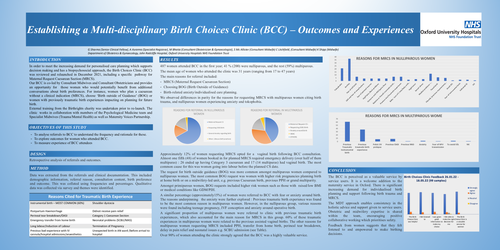
487 women attended BCC in the first year; 41 % (200) were nulliparous, and the rest (59%) multiparous.
The mean age of women who attended the clinic was 31 years (ranging from 17 to 47 years)
The main reasons for referral included:
- MRCS (Maternal Request Caesarean Section)
- Choosing BOG (Birth Outside of Guidance)
- Birth-related anxiety/individualised care planning.
We observed differences in parity for the reasons for requesting MRCS with multiparous women citing birth trauma, and nulliparous women experiencing anxiety and tokophobia.
Approximately 12% of women requesting MRCS opted for a vaginal birth following BCC consultation. Almost one fifth (48) of women booked in for planned MRCS required emergency delivery (over half of them multiparas) : 26 ended up having Category 3 caesarean and 17 (14 multiparas) had vaginal birth. The most common cause for this was women going into labour before the planned CS date.
The request for birth outside guidance (BOG) was more common amongst multiparous women compared to nulliparous women. The most common BOG request was women with higher risk pregnancies planning birth at home birth or on a midwifery-led unit, e.g. previous Caesarean birth, previous PPH or grand multiparity.
Amongst primiparous women, BOG requests included higher risk women such as those with raised/low BMI or medical conditions like GDM/PIH.
A similar percentage (approximately15%) of women were referred to BCC with fear or anxiety around birth. The reasons underpinning the anxiety were further explored : Previous traumatic birth experience was found to be the most common reason in multiparous women. However, in the nulliparous group, various reasons were found including teenage pregnancy, IVF conception and anxiety around operative birth.
A significant proportion of multiparous women were referred to clinic with previous traumatic birth experiences, which also accounted for the main reason for MRCS in this group. 60% of these traumatic experiences in mutltiparas were related to the previous assisted vaginal births. The other reasons for multiparous women requesting MRCS included PPH, transfer from home birth, perineal tear breakdown, delay in pain relief and neonatal issues e.g. SCBU admission
Over 90% of women attending the clinic strongly agreed that the BCC was a highly valuable service.
CONCLUSION
The BCC is perceived as a valuable service by service users. It is a welcome addition to the maternity service in Oxford. There is significant increasing demand for individualised birth planning and support following birth trauma and MRCS.
The MDT approach enables consistency in the holistic advice and support given to service users. Obstetric and midwifery expertise is shared within the team, encouraging positive collaborative working which prioritises safety.
Feedback from women suggests that they felt listened to and empowered to make birthing decisions.