1,830 posters, 67 videos, 75 audios, 29 topics, 22 sessions, 4,727 authors, 1,697 institutions
ePostersLive by SciGen Technologies S.A. All rights reserved.
RCOG World Congress 2023
June 12 - 14, 2023 | London, UK

EP.0268
External Validation of the M6-Progesterone Model in Managing Pregnancies of Unknown Location
Poster Presenter
Authors
Katie Ryan, Sara Ooi, Sarah Mead, Hayley Diplock, Melissa Wang, Bradley De Vries, Joanne Ludlow
Affiliations
Part of Topic
Early Pregnancy Complications and Gynaecology
External Validation of the M6-Progesterone Model in an Australian Population of Pregnancies of Unknown Location
Authors: Dr. Katie Ryan1, Dr. Sara Ooi1, Ms. Sarah Mead1, Ms. Hayley Diplock1, Ms. Melissa Wang1, A/Prof. Bradley De Vries1,2, Dr. Joanne Ludlow1
Objective: The two-step M6 with Progesterone (M6P) model management of Pregnancy of Unknown Location (PUL)1, was shown to perform the best in a cohort of women compared with M4 and M6 without progesterone.2 Subsequently, the M6P model became our guideline for managing PULs. This study was to externally validate the prospective application of the M6P model in predicting ectopic pregnancy (EP) and persistent PUL in women diagnosed with PUL.
Design: A single-centre, retrospective cohort study using the M6P mathematical model in an Australian tertiary hospital Early Pregnancy Assessment Service (EPAS) from 01/06/2020 to 31/05/2021.
Methods: For women with an ultrasound diagnosis of PUL at EPAS, demographic data, clinical history, initial serum progesterone, initial and 48-hour serum BHCG, whether high risk or low risk from the prediction model, pregnancy outcomes and interventions were recorded. These results were cross tabulated to calculate the sensitivity, specificity, negative predictive value and area under the ROC-curve of the model.
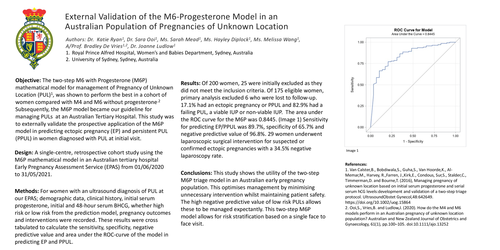
Results: Of 200 women, 25 were excluded as they did not meet inclusion criteria. Of 175 eligible women, primary analysis excluded 6 who were lost to follow-up. 17.1% had an ectopic pregnancy or PPUL and 82.9% had a failing PUL, a viable IUP or non-viable IUP. The area under the ROC curve for the M6P was 0.8445.(Image 1) Sensitivity for predicting EP was 89.7%, specificity of 65.7% and negative predictive value of 96.8%. 29 women underwent laparoscopic surgical intervention for suspected or confirmed ectopic pregnancies with a 34.5% negative laparoscopy rate.
Conclusions: This study shows the utility of the two-step M6P triage model in an Australian early pregnancy population. This optimises management by minimising unnecessary intervention whilst maintaining patient safety. The high negative predictive value of low risk PULs allows these to be managed expectantly. This two-step M6P model allows for risk stratification based on a single face to face visit.