1,830 posters, 67 videos, 75 audios, 29 topics, 22 sessions, 4,727 authors, 1,697 institutions
ePostersLive by SciGen Technologies S.A. All rights reserved.
RCOG World Congress 2023
June 12 - 14, 2023 | London, UK

EP.0257
Great Expectations: developing and validating a new tool for measuring birth expectations
Poster Presenter
Authors
Miriam Toolan, Mariusz Grzeda, Anna Davies, Mary Lynch, Abi Merriel
Affiliations
King's College London, University of Bristol, University of Liverpool
Part of Topic
Innovation
Great Expectations: developing and validating a new tool for measuring expectations of labour and birth
Miriam Toolan1, Mariusz Grzeda2, Anna Davies1, Mary Lynch1, Abi Merriel3,1
1University of Bristol, Bristol, United Kingdom. 2King's College London, London, United Kingdom. 3University of Liverpool, Liverpool, United Kingdom
Abstract
Objective
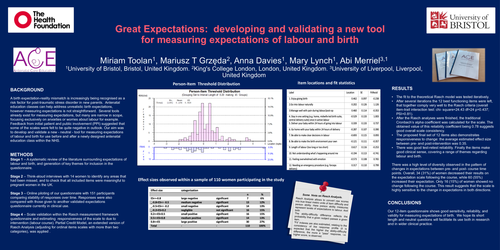
A birth expectation-reality mismatch is increasingly being recognised as a risk factor for post-traumatic stress disorder in new parents. Antenatal education classes can help address unrealistic birth expectations, however measuring expectations is not straightforward. Several tools already exist for measuring expectations, but many are narrow in scope, focusing exclusively on anxieties or worries about labour for example. Feedback from initial patient and public involvement (PPI) suggested that some of the scales were felt to be quite negative in outlook. Our aim was to develop and validate a new - neutral - tool for measuring expectations of labour and birth for use before and after a newly designed antenatal education class within the NHS.
Methods
A multi-disciplinary team including midwives, obstetricians and qualitative researchers drafted an initial questionnaire based on themes identified in a systematic review. “Think-aloud” interviews with pregnant people (14) helped to clarify areas where phraseology or terminology was confusing. Overall, 41 items (grouped within 5 thematic blocks, each referring to specific aspects of the labour process) generated out of these interviews were tested on the sample of 139 pregnant women at two timepoints: before and after antenatal education sessions. All responses from participants were collated and subjected to Rasch analysis.
Stage 1 – A systematic review of the literature surrounding expectations of labour and birth, and generation of key themes for inclusion in the questionnaire.
Stage 2 – Think-aloud interviews with 14 women to identify any areas that had been missed, and to check that all included items were meaningful to pregnant women in the UK.
Stage 3 – Online piloting of our questionnaire with 151 participants comparing stability of responses over time. Responses were also compared with those given to another validated expectations questionnaire currently in clinical use.
Stage 4 – Scale validation within the Rasch measurement framework questionnaire and comparing responses before and after an intervention involving 139 pregnant women (responsiveness of the scale to change).
Results
In the course of analyses the fit to the theoretical Rasch model was tested iteratively. After several iterations 12 items were left, that together comply very well to the Rasch criteria (overall item-trait interaction test: chi- square=24.43 df=24 p=0.437; PSI=0.81). The proposed final set of 12 items also demonstrates responsiveness to change: the average estimated effect size between pre- and post-intervention was 0.35. There was good test-retest reliability. Finally the items make good clinical sense, covering a range of themes regarding labour and birth.
Conclusion
Our 12-item questionnaire shows good sensitivity, reliability, and validity for measuring expectations of birth. We hope its short length and neutral questions will facilitate its use both in research and in wider clinical practice.