1,830 posters, 67 videos, 75 audios, 29 topics, 22 sessions, 4,727 authors, 1,697 institutions
ePostersLive by SciGen Technologies S.A. All rights reserved.
RCOG World Congress 2023
June 12 - 14, 2023 | London, UK

EP.0224
Impact of NIPT on Fetal Anomaly Screening Since Introduction into the NHS
Poster Presenter
Authors
Affiliations
Part of Topic
Advances in Prenatal Diagnosis
IMPACT OF NHS NIPT ON FETAL ANOMALY SCREENING
Sabrina Achim1, JillAtkinson1, VickyJennings1, UmaRajesh1
1Department of Obstetrics and Gynaecology, Hull University Teaching Hospitals NHS Trust
1. Hargrave, J. and van Campen, J. (2022) Non-invasive prenatal testing (NIPT), Genomics Education Programme. Edited by B. Jennings and S. Simpson; 2. Nipt(2023) NIPT: Harmony test, The Harley Street Centre for Women. 3. Woolcock, J. and Grivell, R. (2014) Noninvasiveprenatal testing, Australian Family Physician, Volume 43, Issue 7; 4. Screening for Down’s syndrome, Edwards’ syndrome and Patau’s syndrome(2021) NHS choices; 5. Non-invasive prenatal testing (NIPT) (2022) Antenatal Results and Choices (ARC). 6. Fees(2020) Ultrasound Diagnostic Services. Available at: https://www.uds.uk.com/fees/
Non-invasive prenatal testing (NIPT) is a maternal blood test analysing cell-free maternal and fetal DNA (cfDNA) to screen for chromosomal abnormalities.1
NIPT is offered to women with ‘high-chance’ combined result or Quad screening result, providing a more accurate testing than the traditional serum screening without the possible complications associated with invasive diagnostic tests. It has a high sensitivity for trisomy 21 and 18 (>99%) and 13 (>92%) 2, 3with results categorised into: low-chance, high-chance or inconclusive.
Since June 2021 NIPT is offered by NHS England. 4
INTRODUCTION
We aimed to assess the impact of NHS-funded NIPT on women’s decision-making and preference for antenatal screening.
This is an observational study of prospectively collected data on women attending antenatal clinic at Hull Royal Infirmary (HRI) between April 2018 March 2022. Women with high-chance result on combined test or quadruple marker screening test were offered:
- US scan and continued care with no diagnostic testing
- Diagnostic testing with amniocentesis and/or CVS
- NIPT(women had to fund private NIPT prior to NHS implementation)
Data on type of screening offered and accepted, outcome of the testing and pregnancy were collected. Women with incomplete follow-up or those with TOP/miscarriage prior to testing were excluded.
AIM & METHODOLOGY
Uneventful Pregnancy
TOP
(due to antenatally detected chromosomal abnormality)
Postnatal detection of chromosomal abnormality
Before NHS NIPT
After NHS NIPT
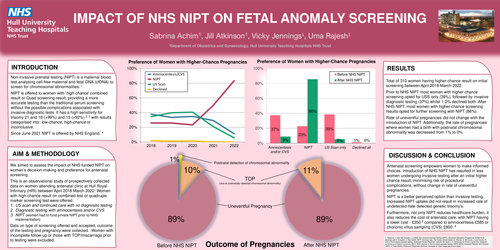
Total of 310 women having higher-chance result on initial screening between April 2018-March 2022.
Prior to NHS NIPT most women with higher-chance screening opted for USS only (39%), followed by invasive diagnostic testing (37%) whilst 1-2% declined both. After NHS NIPT, most women with higher-chance screening results opted for further screening with NIPT (86%).
Rate of uneventful pregnancies did not change with the introduction of NIPT. Additionally, the rate of pregnancies where women had a birth with postnatal chromosomal abnormality was decreased from 1% to 0%.
RESULTS
Preference of Women with Higher-Chance Pregnancies
Antenatal screening empowers women to make informed choices. introduction of NHS NIPT has resulted in less women undergoing invasive testing after an initial higher chance result, minimising risk of procedural complications, without change in rate of uneventful pregnancies.
NIPT is a better perceived option than invasive testing. Increased NIPT uptake did not result in increased rate of undetected /late detected genetic trisomy’s.
Furthermore, not only NIPT reduces healthcare burden, it also reduces the cost of antenatal care; with NIPT having a lower cost -£350 5compared to amniocentesis £585 or 0% 20% 40% 60% 80% 100% 2018 2019 2020 2021 2022 Amniocentesis/CVS NIPT US Scan Declined 37% 23% 39% 1% 9% 86% 5% 0% 0% 20% 40% 60% 80% 100% AMNIOCENTESIS/CVS NIPT US SCAN ONLY DECLINED Before NHS NIPT After NHS NIPT 1% 10% 89% 89% 11%