1,830 posters, 67 videos, 75 audios, 29 topics, 22 sessions, 4,727 authors, 1,697 institutions
ePostersLive by SciGen Technologies S.A. All rights reserved.
RCOG World Congress 2023
June 12 - 14, 2023 | London, UK

PP.0174
The association between second trimester maternal serum alpha-fetoprotein and preterm birth.
Poster Presenter
Authors
Affiliations
Part of Topic
Advances in Prenatal Diagnosis
|
The association between second-trimester maternal serum alpha-fetoprotein and preterm birth Tamar Grdzelishvili1 Zaza Sinauridze2 |
|
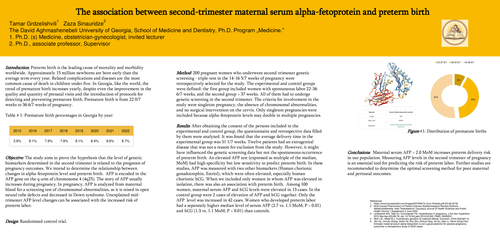
Introduction: Preterm birth is the leading cause of mortality and morbidity worldwide. Approximately 15 million newborns are born early than the average term every year. Related complications and diseases are the most common cause of death in children under five. In Georgia, like the world, the trend of premature birth increases yearly, despite even the improvement in the quality and quantity of prenatal visits and the introduction of protocols for detecting and preventing premature birth. Premature birth is from 22 0/7 weeks to 36 6/7 weeks of pregnancy. Objective: The study aims to prove the hypothesis that the level of genetic biomarkers determined in the second trimester is related to the prognosis of pregnancy outcomes. We intend to determine the relationship between changes in alpha-fetoprotein level and preterm birth. AFP is encoded in the AFP gene on the q-arm of chromosome 4 (4q25). The story of AFP usually increases during pregnancy. In pregnancy, AFP is analyzed from maternal blood for a screening test of chromosomal abnormalities, as it is raised in open neural tube defects and decreased in Down syndrome. Unexplained mid- trimester AFP level changes can be associated with the increased risk of preterm labor. Design: Randomised control trial. Method: 200 pregnant women who underwent second-trimester genetic screening - triple-test in the 14-16 5/7 weeks of pregnancy were retrospectively selected for the study. The experimental and control groups were defined: the first group included women with spontaneous labor 22-36 6/7 weeks, and the second group > 37 weeks. All of them had to undergo genetic screening in the second trimester. The criteria for involvement in the study were singleton pregnancy, the absence of chromosomal abnormalities, and no surgical intervention on the cervix. Only singleton pregnancies were included because alpha-fetoprotein levels may double in multiple pregnancies. Results: After obtaining the consent of the persons included in the experimental and control group, the questionnaire and retrospective data filled by them were analyzed. It was found that the average delivery time in the experimental group was 31 1/7 weeks. Twelve patients had an extragenital disease that was not a reason for exclusion from the study. However, it might have influenced the genetic screening data but not the spontaneous occurrence of preterm birth. An elevated AFP test (expressed as multiple of the median, MoM) had high specificity but low sensitivity to predict preterm birth. In these studies, AFP was measured with two other biomarkers (Human chorionic gonadotrophin, Estriol), which were often elevated, especially human chorionic hCG. When we included only women in whom AFP was elevated in isolation, there was also an association with preterm birth. Among 100 women, maternal serum AFP and hCG levels were elevated in 13 cases. In the control group were 2 cases of elevation of AFP and hCG together. Only the AFP level was increased in 42 cases. Women who developed preterm labor had a separately higher median level of serum AFP (2.7 vs. 1.1 MoM; P < 0.01) and hCG (1.3 vs. 1.1 MoM; P < 0.01) than controls. Conclusions: Maternal serum AFP > 2.0 MoM increases preterm delivery risk in our population. Measuring AFP levels in the second trimester of pregnancy is an essential tool for predicting the risk of preterm labor. Further studies are recommended to determine the optimal screening method for poor maternal and perinatal outcomes. |