1,830 posters, 67 videos, 75 audios, 29 topics, 22 sessions, 4,727 authors, 1,697 institutions
ePostersLive by SciGen Technologies S.A. All rights reserved.
RCOG World Congress 2023
June 12 - 14, 2023 | London, UK

PP.0014
Pyridoxine - Dependent Epilepsy of neonate: Obstetric role - Experience from developing country.
Poster Presenter
Part of Topic
Advances in Prenatal Diagnosis
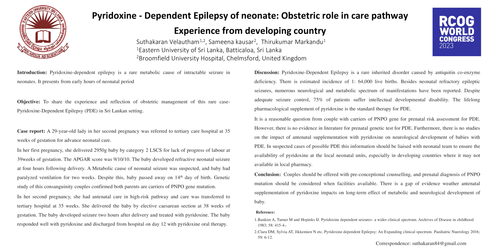
Pyridoxine - Dependent Epilepsy of neonate: Obstetric role in care pathway
Experience from developing country
Suthakaran Velautham1,2, Sameena kausar2, Thirukumar Markandu1
1Eastern University of Sri Lanka, Batticaloa, Sri Lanka
2Broomfield University Hospital, Chelmsford, United Kingdom
Introduction: Pyridoxine-dependent epilepsy is a rare metabolic cause of intractable seizure in neonates. It presents from early hours of neonatal period
Objective: To share the experience and reflection of obstetric management of this rare case-Pyridoxine-Dependent Epilepsy (PDE) in Sri Lankan setting.
Case report: A 29-year-old lady in her second pregnancy was referred to tertiary care hospital at 35 weeks of gestation for advance neonatal care.
In her first pregnancy, she delivered 2950g baby by category 2 LSCS for lack of progress of labour at 39weeks of gestation. The APGAR score was 9/10/10. The baby developed refractive neonatal seizure at four hours following delivery. A Metabolic cause of neonatal seizure was suspected, and baby had paralyzed ventilation for two weeks. Despite this, baby passed away on 14th day of birth. Genetic study of this consanguinity couples confirmed both parents are carriers of PNPO gene mutation.
In her second pregnancy, she had antenatal care in high-risk pathway and care was transferred to tertiary hospital at 35 weeks. She delivered the baby by elective caesarean section at 38 weeks of gestation. The baby developed seizure two hours after delivery and treated with pyridoxine. The baby responded well with pyridoxine and discharged from hospital on day 12 with pyridoxine oral therapy.
Discussion: Pyridoxine-Dependent Epilepsy is a rare inherited disorder caused by antiquitin co-enzyme deficiency. There is estimated incidence of 1: 64,000 live births. Besides neonatal refractory epileptic seizures, numerous neurological and metabolic spectrum of manifestations have been reported. Despite adequate seizure control, 75% of patients suffer intellectual developmental disability. The lifelong pharmacological supplement of pyridoxine is the standard therapy for PDE.
It is a reasonable question from couple with carriers of PNPO gene for prenatal risk assessment for PDE. However, there is no evidence in literature for prenatal genetic test for PDE. Furthermore, there is no studies on the impact of antenatal supplementation with pyridoxine on neurological development of babies with PDE. In suspected cases of possible PDE this information should be liaised with neonatal team to ensure the availability of pyridoxine at the local neonatal units, especially in developing countries where it may not available in local pharmacy.
Conclusion: Couples should be offered with pre-conceptional counselling, and prenatal diagnosis of PNPO mutation should be considered when facilities available. There is a gap of evidence weather antenatal supplementation of pyridoxine impacts on long-term effect of metabolic and neurological development of baby.
Reference:
Correspondence: suthakaran84@gmail.com