1,830 posters, 67 videos, 75 audios, 29 topics, 22 sessions, 4,727 authors, 1,697 institutions
ePostersLive by SciGen Technologies S.A. All rights reserved.
RCOG World Congress 2023
June 12 - 14, 2023 | London, UK

EP.0115
Knowledge and attitudes towards non-invasive prenatal testing (NIPT) Sri Lankan pregnant women
Part of Topic
Advances in Prenatal Diagnosis
Audio
KNOWLEDGE AND ATTITUDE TOWARDS NON INVASIVE PRENATAL TESTING(NIPT) AMONG SRI LANKAN PREGNANT WOMEN
Padmapani Padeniya ,Gayashan B. Wickramarachchi, Thilina Jayawardhana, Tiran Dias
INTRODUCTION
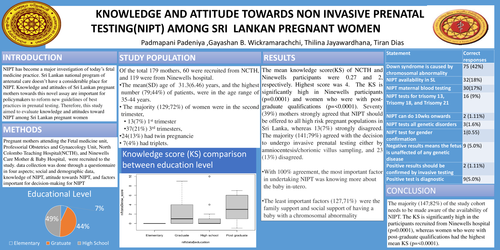
NIPT has become a major investigation of today’s fetal medicine practice. Sri Lankan national program of antenatal care doesn’t have a considerable place for NIPT. Knowledge and attitudes of Sri Lankan pregnant mothers towards this novel assay are important for policymakers to reform new guidelines of best practices in prenatal testing. Therefore, this study aimed to evaluate knowledge and attitudes toward NIPT among Sri Lankan pregnant women
METHODS
Pregnant mothers attending the Fetal medicine unit, Professorial Obstetrics and Gynaecology Unit, North Colombo Teaching Hospital(NCTH), and Ninewells Care Mother & Baby Hospital, were recruited to the study. data collection was done through a questionnaire in four aspects; social and demographic data, knowledge of NIPT, attitude towards NIPT, and factors important for decision-making for NIPT
STUDY POPULATION
Of the total 179 mothers, 60 were recruited from NCTH, and 119 were from Ninewells hospital.
RESULTS
The mean knowledge score(KS) of NCTH and Ninewells participants were 0.27 and 2, respectively. Highest score was 4. The KS is significantly high in Ninewells participants (p=0.0001) and women who were with post-graduate qualifications (p=<0.0001). Seventy (39%) mothers strongly agreed that NIPT should be offered to all high risk pregnant populations in Sri Lanka, whereas 13(7%) strongly disagreed. The majority (141;79%) agreed with the decision to undergo invasive prenatal testing either by amniocentesis/chorionic villus sampling, and 23 (13%) disagreed.
CONCLUSION
The majority (147;82%) of the study cohort needs to be made aware of the availability of NIPT. The KS is significantly high in the participants recruited from Ninewells hospital (p=0.0001), whereas women who were with post-graduate qualifications had the highest mean KS (p=<0.0001).