1,830 posters, 67 videos, 75 audios, 29 topics, 22 sessions, 4,727 authors, 1,697 institutions
ePostersLive by SciGen Technologies S.A. All rights reserved.
RCOG World Congress 2023
June 12 - 14, 2023 | London, UK

PP.0204
A rare case of Hamman's syndrome and literature review
Poster Presenter
Authors
Affiliations
Part of Topic
Early Pregnancy Complications and Gynaecology
A Rare Case of Hamman’s Syndrome and Literature Review
Objective
We report a rare case of Hamman's syndrome developed in the second trimester following retching due to Hyperemesis Gravidarum [HG] .
Case Report
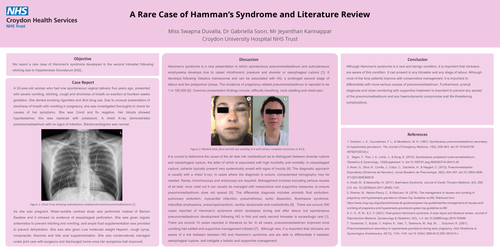
A 32-year-old woman who had one spontaneous vaginal delivery five years ago, presented with severe vomiting, retching, cough and shortness of breath on exertion at fourteen weeks gestation. She denied smoking cigarettes and illicit drug use. Due to unusual presentation of shortness of breath with vomiting in pregnancy, she was investigated thoroughly to check for causes of her symptoms. She was Covid and flu negative. Her bloods showed hypokalaemia; this was replaced with potassium. A chest X-ray demonstrated pneumomediastinum with no signs of infection. Electrocardiogram was normal.
As she was pregnant, Water-soluble contrast study was performed instead of Barium Swallow and it showed no evidence of oesophageal perforation. She was given regular antiemetics to prevent retching and vomiting, and ample fluid supplementation was provided to prevent dehydration. She was also given Low molecular weight Heparin, cough syrup, omeprazole, thiamine and folic acid supplementation. She was conservatively managed under joint care with surgeons and discharged home once her symptoms had improved.
Discussion
Hamman’s syndrome is a rare presentation in which spontaneous pneumomediastinum and subcutaneous emphysema develops due to raised intrathoracic pressure and alveolar or oesophageal rupture [1]. It develops following Valsalva manoeuvres and can be associated with HG, a prolonged second stage of labour and the postpartum phase. The incidence of pregnancy related pneumomediastinum is reported to be 1 in 100,000 [2]. Common presentation findings include: difficulty breathing, neck swelling and chest pain.
It is crucial to determine the cause of the air leak into mediastinum as to distinguish between alveolar rupture and oesophageal rupture, the latter of which is associated with high morbidity and mortality. In oesophageal rupture, patients typically present very systemically unwell with signs of toxicity [4]. The diagnostic approach is usually with a chest X-ray; in cases where the diagnosis is unsure, computerised tomography may be needed. Rarely, bronchoscopy and endoscopy are required. Management involves excluding serious causes of air leak; once ruled out it can usually be managed with reassurance and supportive measures, to ensure pneumomediastinum does not spread [5]. The differential diagnosis includes amniotic fluid embolism, pulmonary embolism, myocardial infarction, pneumothorax, aortic dissection, Boerhaave syndrome, interstitial emphysema, pneumopericardium, cardiac tamponade and mediastinitis [6]. There are around 200 cases reported of Hamman’s syndrome which developed during and after labour but spontaneous pneumomediastinum development following HG in first and early second trimester is exceedingly rare [1]. There are around 10 cases reported in literature so far. In all cases, pneumomediastinum improved once vomiting had settled and supportive management initiated [7]. Although rare, it is important that clinicians are aware of a link between between HG and Hamman’s syndrome and are able to differentiate it between oesophageal rupture, and instigate a holistic and supportive management.
Conclusion
Although Hamman's syndrome is a rare and benign condition, it is important that clinicians are aware of this condition. It can present in any trimester and any stage of labour. Although most of the time patients improve with conservative management, it is important to differentiate with more serious causes of pneumomediastinum. Furthermore, prompt diagnosis and close monitoring with supportive treatment is important to prevent any spread of the pneumomediastinum and any haemodynamic compromise and life-threatening complications.