1,830 posters, 67 videos, 75 audios, 29 topics, 22 sessions, 4,727 authors, 1,697 institutions
ePostersLive by SciGen Technologies S.A. All rights reserved.
RCOG World Congress 2023
June 12 - 14, 2023 | London, UK

PP.0177
Outcomes of early-onset fetal growth restriction defined by the international Delphi consensus
Poster Presenter
Part of Topic
Advances in Prenatal Diagnosis
Video
Outcomes of early-onset fetal growth restriction defined by the International Delphi consensus
Kunio Tanaka1), Yoshifumi Kasuga1), Keisuke Akita1), Junko Tamai1), Asuka Hamuro1), Yuka Fukuma1), Yuya Tanaka1), Keita Hasegawa1), Toshimitsu Otani1), Satoru Ikenoue1), Takane Kim2), Mariko Hida2), Mamoru Tanaka1)
1)Department of Obstetrics and Gynecology, Keio University School of Medicine, Japan
2) Department of Pediatrics, Keio University School of Medicine, Japan
Abstract
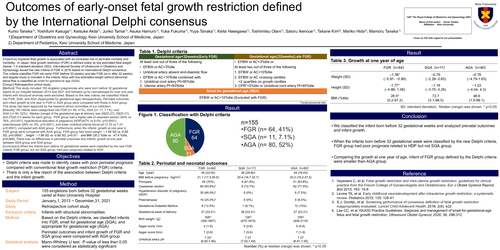
[Objective] Impaired fetal growth is associated with an increased risk of perinatal mortality and morbidity. In Japan, fetal growth restriction (FGR) is defined solely by low estimated fetal weight (below -1.5 standard deviation (SD)). International Society of Ultrasound in Obstetrics and Gynecology issued the new criteria of FGR in 2016 based on international Delphi consensus. This criteria classifies FGR into early FGR (before 32 weeks) and late FGR (at or after 32 weeks), and doppler study is included in the criteria; fetus with low estimated weight without abnormal blood flow is classified as small for gestational age (SGA).
[Design] Retrospective cohort study.
[Method] This study included 155 singleton pregnancies who were born before 32 gestational weeks at our hospital between 2013 and 2021 and followed up by neonatologist for over one year. Infants with structural anomaly were excluded. Based on the new criteria, we classified infants into FGR, SGA, and AGA (Appropriate for gestational age) retrospectively. Perinatal outcomes and infant growth at one year in FGR or SGA group were compared with those in AGA group. This study has been approved by the research ethics committee of our institution.
[Results] 155 infants were categorized into FGR (n= 64, 41%), SGA (n= 11, 7.1%), and AGA (n= 80, 52%). Median [range] of the gestational age at delivery was 28[22-31], 29[22-31], and 27[22-31] weeks for each group. FGR group had a higher rate of cesarean section (94% vs 78%, p=0.001), hypertensive disorders of pregnancy (HDP)(47% vs 8.5%, p<0.0001), preeclampsia (26% vs. 6%, p<0.0001), and lower umbilical arterial blood pH (7.33 vs 7.37, p<0.0001), compared with AGA group. Furthermore, when the infants’ growth at one year in FGR group were compared with AGA group, FGR group had lower weight(-1.44 SD vs -0.85 SD, p=0.0005), height(-1.86 SD vs -0.85 SD, p=0.01) and BMI (30.2 %tile vs 47.4 %tile, p=0.004). There was no differences in perinatal outcomes and infants’ growth at one year between SGA group and AGA group.
[Conclusion] When the infants born before 32 gestational weeks were classified by the new FGR criteria, FGR group, but not SGA group, had poor prognosis related to HDP.
Objective
Subject 155 singletons born before 32 gestational weeks cared at Keio University Hospital. Study Period January,1, 2013 ~ December,31, 2021. Study Retrospective cohort study. Exclusion criteria Infants with structural abnormalities.Method Based on the Delphi criteria, we classified infants into FGR, small for gestational age (SGA), and appropriate for gestational age (AGA) Perinatal outcomes and infant growth of FGR and SGA group were compared with AGA group. Statistical analysis Mann-Whitney U test. P-value of less than 0.05 were considered as statistically significant
Result
Figure 1. Classification with Delphi criteria. Table 2. Perinatal and neonatal outcomes. Table 3. Growth at one year of age
Conclusion
We classified the infant born before 32 gestational weeks and analyzed prenatal outcomes and infant growth.When the infants born before 32 gestational week were classified by the new Delphi criteria, FGR group had poor prognosis related to HDP but not SGA group. Comparing the growth at one year of age, infant of FGR group defined by the Delphi criteria were smaller than AGA group.
Reference