1,830 posters, 67 videos, 75 audios, 29 topics, 22 sessions, 4,727 authors, 1,697 institutions
ePostersLive by SciGen Technologies S.A. All rights reserved.
RCOG World Congress 2023
June 12 - 14, 2023 | London, UK

PP.0172
Digital Inequalities in Healthcare - a Maternity Services Evaluation.
Poster Presenter
Authors
Affiliations
Part of Topic
Innovation
Digital Inequalities in Healthcare - a Maternity Services Evaluation
The impact of digital healthcare on vulnerable pregnant women: A review of the use of the MyCare app in the maternity
department at a central London tertiary unit
Pierce, P.,1 Adil, H.,1 Whitten, M.2,3 and Hillman, S.2,3
1Medical School, Faculty of Medical Sciences, University College London, London, United Kingdom, 2Women’s Health Division, Elizabeth Garrett Anderson Wing, University College London Hospital NHS Foundation Trust, London, United Kingdom, 3Department of Maternal and Fetal Medicine, EGA Institute for Women’s Health, University College London, London, United Kingdom.
Background
Digitalisation offers innovative solutions within maternity services; however, vulnerable groups risk being overlooked.
This research sought to investigate the impact of digital health on vulnerable pregnant women in University College London Hospital (UCLH), a university-affiliated tertiary centre with a large and diverse patient population and approximately 6,000 births annually.
In 2019, UCLH introduced an electronic health records system (EPIC), streamlining clinical health information. The maternity department became one of the first in the Trust to go entirely paperless when it piloted MyCare, the patient portal app tethered to EPIC. The intended rationale was to fulfil the needs of an already very engaged patient group, giving women access to test results, information about appointments and health-related updates, and enabling communication with healthcare professionals (HCPs). Attesting to its popularity, a recent audit revealed 97% of pregnant women had downloaded the app, but engagement levels or information about those who had not downloaded it was difficult to identify from routine reporting metrics.
Aims
The overarching aims of this research were to quantify the use of MyCare, an electronic patient portal, among pregnant women, and to investigate whether any disparities existed relating to patients’ socio-demographics or characteristics.
In addition, this work aimed to gain insight into vulnerable pregnant women’s views about using MyCare, and to identify the perceived utility of portal features alongside any potential barriers to adoption and engagement. The study also aimed to gain a broad overview of the HCP response to its implementation, noting any proposed improvements for the app.
Methodology
Research was conducted over a 3-month period (April 2022 - June 2022) in the Maternity Department at UCLH, London, UK.
Two datasets were collected and statistically analysed: (1) Pregnant women booked in at UCLH during February 2022 and their engagement with MyCare (N=636), and (2) women who had received maternity care at UCLH after the implementation of MyCare in 2019, but who had never downloaded it during their pregnancy (N=250).
In addition, anonymised surveys were completed by vulnerable pregnant women (N=22), obtained through purposive sampling; and HCPs (N=62), obtained through opportunity sampling. Inductive thematic analysis was performed.
To identify vulnerable pregnant women across all datasets, “vulnerability” was identified using the “Complex Social Factors in the Perinatal Period (Version 3)” UCLH guideline, adapted from the 2010 NICE guidelines on “Pregnancy and Social Factors”.
Results
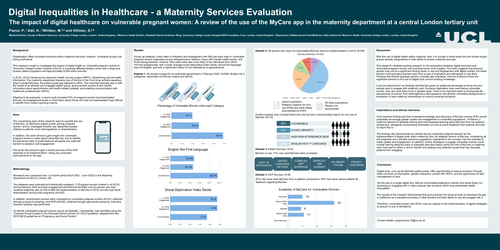
Across all datasets, lower rates of utilisation and engagement with MyCare were seen in vulnerable pregnant women especially among refugee/asylum seekers, those with mental health issues, and those facing domestic violence. Non-users were also more likely to be individuals from ethnic minority backgrounds, with a lower average social-deprivation-index decile, whose first language was not English, and with a significant history of non-attendance to appointments.
Discussion
With the rise of digital health within maternity care, it is unclear to what extent this will further impact groups already marginalised in their ability to access maternity services. This research validates existing research on the association between digital exclusion and vulnerable pregnant women and provides some novel insights. The work suggests that physical access may not be a significant limiting factor to use and engagement with digital portals, but rather that the most pervasive barriers stem from a lack of motivation and willingness to use them. Findings that limited language options, complex app interfaces, and low e-literacy levels are significant barriers to the use of digital tools mirrors existing knowledge. It can be inferred from our findings that MyCare gives an additional advantage to those who are already able to engage with maternity care. Exclusive digitisation risks overlooking vulnerable women, who are more likely to be in greater need.
There is an important need to incorporate the perspectives of women from heterogeneous demographics and diverse vulnerable backgrounds in evaluation of new maternity interventions to ensure universal inclusivity.
Implications and clinical relevance
One important finding was that increased knowledge and advocacy of MyCare among HCPs would potentially encourage greater uptake and engagement in vulnerable populations. Therefore, it might be relevant to facilitate training that encompasses learning about MyCare from the patients’ perspective, alongside incorporating information on how to solicit feedback from patients and who to report this to.
The findings also demonstrate an interest among vulnerable pregnant women for the implementation of digital tools within maternity care. An adapted version of MyCare, considering all the pragmatic and culturally sensitive suggestions highlighted in the surveys, has the potential to foster uptake and engagement. In addition, further strategies to engage vulnerable women could include training sessions early in antenatal care that clearly clarify the role of MyCare in maternity care, how best to utilise it, and to identify and address any potential issues that may dissuade patients from engaging.
Overall, the success of MyCare and digital health requires synergy between HCPs and patients as empowering both groups is critical in realising any benefits associated with patient portals.
Conclusion
Digital tools, such as the MyCare patient portal, offer opportunities to reduce exclusion through wider provision of information, greater interactive contact with HCPs, and the opportunity for self- management of care. Yet the use of a single digital tool, without a formulated pathway to identify and assist those not accessing or engaging with it, risks unequal care provision which may exacerbate health inequalities. The results of this research demonstrate that giving women the physical tools to download the app is ineffective as a standalone solution if other barriers limit their ability to use and engage with it. Therefore, vulnerable women and HCPs must be integral to the implementation of digital strategies, to ensure no one is left behind.
Contact details: poppy.pierce.19@ucl.ac.uk