1,830 posters, 67 videos, 75 audios, 29 topics, 22 sessions, 4,727 authors, 1,697 institutions
ePostersLive by SciGen Technologies S.A. All rights reserved.
RCOG World Congress 2023
June 12 - 14, 2023 | London, UK

PP.0132
Pregnancy Care Integrating translational Science, Everywhere (PRECISE) Network - Findings From Mozambique.
Poster Presenter
Part of Topic
Imaging in Obstetrics
Objectives
The Pregnancy Care Integrating translational Science, Everywhere (PRECISE) prospective cohort study was established in 2018 in three sub-Sahara African (SSA) regions, with the aim of creating a network investigating important placental complications of pregnancy. The aim of this secondary data analysis of the PRECISE cohort in Mozambique is to examine the impact of ultrasound dating on the prevalence of preterm (<37+0 weeks), post-term (>42+0 weeks) and small for gestational age (SGA) births in the region, as defined by ultrasound (USS) dating.
Design
The aim of the PRECISE study is to establish a network through a shared project investigating three important placental complications of pregnancy: high blood pressure (pregnancy hypertension), fetal growth restriction and stillbirth1. The PRECISE study will ultimately develop a unique cohort of biologically and contextually characterised pregnant and nonpregnant women of a reproductive age in SSA. PRECISE has recruited ~10,000 unselected pregnant women aged 14-49 years old living in both urban and rural settings in three sites - The Gambia (Farafenni), Kenya (Kilifi County), and Mozambique (Maputo Province) over two years. The ‘deep phenotyping’ of these women required recording social determinants of health, demographic and clinical parameters, placental biology and agnostic discovery biology. Pregnant women were approached at booking visits. For those who consented to participate, baseline demographic, non-clinical and clinical data with blood, urine and vaginal swab samples throughout the pregnancy and postpartum period were obtained to derive normative ranges for pregnant women. This analysis examines the outcomes in cohort 2, where the inclusion criteria were pregnant women attending the facility and had not been referred from another facility. Exclusion criteria included women who did not plan to deliver at the facility. If a woman was not identified and recruited at her booking visit (and had not declined participation), she was approached at next visit and, if informed consent obtained, recruited into the PRECISE study.
Methods
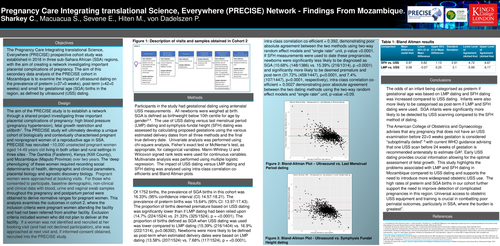
Participants in the study had gestational dating using antenatal USS measurements . All newborns were weighed at birth. SGA is defined as birthweight below 10th centile for age by gender2-4. The use of USS dating versus last menstrual period (LMP) dating and symphysis-fundal height (SFH) dating was assessed by calculating proposed gestations using the various estimated delivery dates from all three methods and the final true delivery date. Univariate analysis was performed using chi-square analysis, Fisher’s exact test or McNemar’s test, as appropriate, for categorical variables. Mann-Whitney U and Wilcoxon signed rank tests were used for continuous variables. Multivariate analysis was performed using multiple logistic regression. The impact of USS dating versus LMP dating and SFH dating was analysed using intra-class correlation co-efficients and Bland Altman plots.
Results
Of 1752 births, the prevalence of SGA births in this cohort was 16.33% (95% confidence interval (CI) 14.57-18.21). The prevalence of preterm births was 15.64% (95% CI: 13.97-17.43). The proportion of births deemed premature based on USS dating was significantly lower than if LMP dating had been relied upon (14.7% (224/1524) vs. 21.33% (325/1524), p = <0.0001). The proportion of births defined as SGA when USS dating was used was lower compared to LMP dating (15.39% (216/1404) vs. 16.9% (222/1314), p=0.06392). Newborns were more likely to be defined as post-term when estimated delivery dates were based on LMP dating (13.58% (207/1524) vs. 7.68% (117/1524), p = <0.0001), intra-class correlation co-efficient = 0.392, demonstrating poor absolute agreement between the two methods using two-way random effect models and “single rater” unit, p-value <0.0001. If SFH measurements were used to date these pregnancies, newborns were significantly less likely to be diagnosed as SGA (10.68% (148/1386) vs. 15.39% (216/1314), p <0.0001) and significantly more likely to be deemed premature and post-term (31.72% (459/1447), p<0.0001, and 7.4% (107/1447), p<0.0001, respectively), intra-class correlation co-efficient = 0.0027 demonstrating poor absolute agreement between the two dating methods using the two-way random effect models and “single rater” unit, p-value =0.09.
Conclusions
The odds of an infant being categorised as preterm if gestational age was based on LMP dating and SFH dating was increased compared to USS dating. Infants were also more likely to be categorised as post-term if LMP and SFH dating were used. SGA infants were significantly more likely to be detected by USS scanning compared to the SFH method of dating.
The American College of Obstetrics and Gynaecology advises that any pregnancy that does not have an USS examination before 22+0 weeks gestation is considered “suboptimally dated” 5 with current WHO guidance advising that one USS scan before 24 weeks of gestation is recommended antenatally to estimate GA6. Early USS dating provides crucial information allowing for the optimal assessment of fetal growth. This study highlights the problems associated with LMP and SFH dating in Mozambique compared to USS dating and supports the need to introduce more widespread obstetric USS use. The high rates of preterm and SGA births in our cohort further support the need to improve detection of complicated pregnancies in this region. Universal access to obstetric USS equipment and training is crucial in combatting poor perinatal outcomes, particularly in SSA, where the burden is greatest7.
References
1. von Dadelszen P, Flint-O’Kane M, Poston L, Craik R, Russell D, Tribe RM, et al. The PRECISE (PREgnancy Care Integrating translational Science, Everywhere) Network’s first protocol: deep phenotyping in three sub-Saharan African countries. Reproductive Health. 2020 Apr 30;17(1):51.
2. Alexander GR, Himes JH, Kaufman RB, Mor J, Kogan M. A United States National Reference for Fetal Growth. Obstetrics & Gynecology. 1996 Feb;87(2):163–8.
3. de Onis M, Habicht JP. Anthropometric reference data for international use: recommendations from a World Health Organization Expert Committee. Am J Clin Nutr. 1996 Oct;64(4):650–8.
4. WHO Expert Committee on Physical Status : the Use and Interpretation of Anthropometry (1993 : Geneva S, World Health Organization. Physical status : the use of and interpretation of anthropometry , report of a WHO expert committee. Utilisation et interprétation de l’ anthropométrie : rapport d’ un comité OMS d’ experts [Internet]. 1995; Available from: https://apps.who.int/iris/handle/10665/37003
5. American College of Obstetricians and Gynecologists. Committee Opinion No. 688: Management of Suboptimally Dated Pregnancies. Obstetrics & Gynecology. 2017 Mar;129(3):e29–32.
6. Agten AK, Xia J, Servante JA, Thornton JG, Jones NW. Routine ultrasound for fetal assessment before 24 weeks’ gestation. Cochrane Database of Systematic Reviews [Internet]. 2021 [cited 2022 Aug 25];(8). Available from: https://www.cochranelibrary.com/cdsr/doi/10.1002/14651858.CD014698/full
7. Wanyonyi SZ, Mariara CM, Vinayak S, Stones W. Opportunities and Challenges in Realizing Universal Access to Obstetric Ultrasound in Sub-Saharan Africa. Ultrasound Int Open. 2017 Apr;3(2):E52–9.