1,830 posters, 67 videos, 75 audios, 29 topics, 22 sessions, 4,727 authors, 1,697 institutions
ePostersLive by SciGen Technologies S.A. All rights reserved.
RCOG World Congress 2023
June 12 - 14, 2023 | London, UK

PP.0124
Nutritional intake, weight change and quality of life in Hyperemesis Gravidarum
Poster Presenter
Authors
Affiliations
University of Plymouth, UK Pregnancy Sickness Support Charity
Part of Topic
Early Pregnancy Complications and Gynaecology
Title: Nutritional intake, weight change and quality of life in Hyperemesis Gravidarum
Authors: Kate Maslin1, Caitlin Dean2,3, Jill Shawe1,4
1. University of Plymouth, Devon, UK. 2. UK Pregnancy Sickness Support Charity, Bodmin, UK.
3. Amsterdam UMC, University of Amsterdam, Amsterdam, the Netherlands.
4. Royal Cornwall Hospital NHS Trust, Truro, UK.
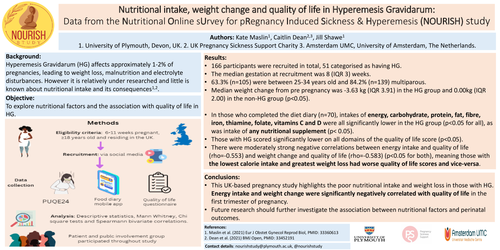
Background: Hyperemesis Gravidarum (HG) affects approximately 1-2% of pregnancies, leading to weight loss, malnutrition and electrolyte disturbances. However it is relatively under researched and little is known about nutritional intake and its consequences1,2.
Objective: To explore nutritional factors and the association with quality of life in HG.
Design: The Nutritional Online sUrvey for pRegnancy Induced Sickness & Hyperemesis (NOURISH) study is a United Kingdom (UK) based online prospective survey study.
Method: People experiencing pregnancy sickness were recruited, alongside a control group not experiencing sickness, via social media and national pregnancy charities in 2021. The eligibility criteria were being between 6-11 weeks pregnant, ≥18 years old and residing in the UK. Participants completed a self-report online questionnaire including the Pregnancy Unique Quantification of Emesis score, the Nausea and Vomiting of Pregnancy Quality of Life questionnaire and an online diet diary. Descriptive statistics, Mann Whitney, Chi square tests and Spearmann bivariate correlations were calculated. A patient and public involvement group participated throughout the study
Results: 166 participants were recruited in total, 51 categorised as having HG. The median gestation at recruitment was 8 (IQR 3) weeks. 63.3% (n=105) were between 25-34 years old and 84.2% (n=139) multiparous. Median weight change from pre pregnancy was -3.63 kg (IQR 3.91) in the HG group and 0.00kg (IQR 2.00) in the non-HG group (p<0.05).
In those who completed the diet diary (n=70), intakes of energy, carbohydrate, protein, fat, fibre, iron, thiamine, folate, vitamins C and D were all significantly lower in the HG group (p<0.05 for all), as was intake of any nutritional supplement (p< 0.05).
Those with HG scored significantly lower on all domains of the quality of life score (p<0.05). There were moderately strong negative correlations between energy intake and quality of life (rho=-0.553) and weight change and quality of life (rho=-0.583) (p<0.05 for both), meaning those with the lowest calorie intake and greatest weight loss had worse quality of life scores and vice-versa.
Conclusions: This UK-based pregnancy study highlights the poor nutritional intake and weight loss in those with HG. Energy intake and weight change were significantly negatively correlated with quality of life in the first trimester of pregnancy. Future research should further investigate the association between nutritional factors and perinatal outcomes.
References
1. Maslin et al. (2021) Eur J Obstet Gynecol Reprod Biol, PMID: 33360613
2. Dean et al. (2021) BMJ Open, PMID: 33452191