1,830 posters, 67 videos, 75 audios, 29 topics, 22 sessions, 4,727 authors, 1,697 institutions
ePostersLive by SciGen Technologies S.A. All rights reserved.
RCOG World Congress 2023
June 12 - 14, 2023 | London, UK

PP.0092
Post-coital Calamity
Poster Presenter
Authors
Affiliations
Part of Topic
Early Pregnancy Complications and Gynaecology
|
Post-coital Calamity – case report of small bowel obstruction presenting with gynaecological symptoms I Griffith, S Dalmia, A Mitchell |
||
|
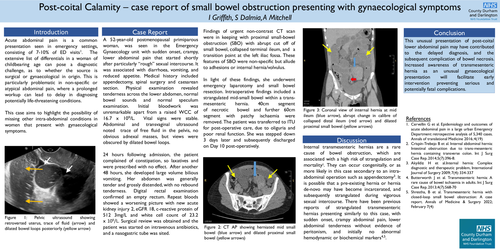
Introduction Acute abdominal pain is a common presentation seen in emergency settings, consisting of 7-10% of ED visits1. The extensive list of differentials in a woman of childbearing age can pose a diagnostic challenge, as to whether the source is surgical or gynaecological in origin. This is particularly problematic in non-specific or atypical abdominal pain, where a prolonged workup can lead to delay in diagnosing potentially life-threatening conditions. This case aims to highlight the possibility of missing other intra-abdominal conditions in women that present with gynaecological symptoms. Case Report A 52-year-old postmenopausal primiparous woman, was seen in the Emergency Gynaecology unit with sudden onset, crampy, lower abdominal pain that started shortly after particularly “rough” sexual intercourse. It was associated with diarrhoea, vomiting, and reduced appetite. Medical history included appendectomy, spinal surgery and caesarean section. Physical examination revealed tenderness across the lower abdomen, normal bowel sounds and normal speculum examination. Initial bloodwork was unremarkable apart from a raised WCC of 16.7 x 10⁹/L. Vital signs were stable. Abdominal and transvaginal ultrasound noted trace of free fluid in the pelvis, no obvious adnexal masses, but views were obscured by dilated bowel loops. 24 hours following admission, the patient complained of constipation, so laxatives and were prescribed with no effect. After another 48 hours, she developed large volume bilious vomiting. Her abdomen was generally tender and grossly distended, with no rebound tenderness. Digital rectal examination confirmed an empty rectum. Repeat bloods showed a worsening picture with new acute kidney injury 2, eGFR 18, c-reactive protein of 512 3mg/L and white cell count of 23.2 x 10⁹/L. Surgical review was obtained and the patient was started on intravenous antibiotics, and a nasogastric tube was sited. Findings of urgent non-contrast CT scan were in keeping with proximal small-bowel obstruction (SBO) with abrupt cut off of small bowel, collapsed terminal ileum, and a transition point at the left iliac fossa. These features of SBO were non-specific but allude to adhesions or internal hernia/volvulus. In light of these findings, she underwent emergency laparotomy and small bowel resection. Intraoperative findings included a strangulated mid-small bowel within a trans- mesenteric hernia. 40cm segment of necrotic bowel and further 60cm segment with patchy ischaemia were rem oved. The patient was transferred to I TU for post-operative care, due to oliguria and poor renal function. She was stepped down 3 days later and subsequently discharged on Day 10 post-operatively. Figure 2: CT AP showing herniated mid small bowel (blue arrow) and dilated proximal small bowel (yellow arrows) Figure 3: Coronal view of internal hernia at mid ileum (blue arrow), abrupt change in calibre of
collapsed distal ileum (red arrow) and dilated References proximal small bowel (yellow arrows) Discussion Internal transmesenteric hernias are a rare cause of bowel obstruction, which are associated with a high risk of strangulation and mortality2. They can occur congenitally, or as more likely in this case secondary to an intra- 3 abdominal operation such as appendectomy . It is possible that a pre-existing hernia or hernia de-novo may have become incarcerated, and subsequently strangulated during vigorous sexual intercourse. There have been previ ous reports of strangulated transmesenteric hernias presenting similarly to this case, with sudden onset, crampy abdominal pain, lower abdominal tenderness without evidence of peritonism, and initially no abnormal hemodynamic or biochemical markers4, 5. 1. Cervellin G et al. Epidemiology and outcomes of acute abdominal pain in a large urban Emergency Department: retrospective analysis of 5,340 cases. Annals of translational Medicine 2016; 4(19) 2. Crispín-Trebejo B et al. Internal abdominal hernia: Intestinal obstruction due to trans-mesenteric hernia containing transverse colon. Int J Surg Case Rep. 2014;5(7):396-8. 3. Akyildiz H et al.Internal hernia: Complex diagnostic and therapeutic problem, International Journal of Surgery 2009; 7(4): 334-337 4. Butterworth J et al. Transmesenteric hernia: A rare cause of bowel ischaemia in adults. Int J Surg Case Rep. 2013;4(7):568-70 5. Shrestha, B et al. Transmesenteric hernia with c l o s e d - l o o p s m a l l b o we l o b s t r u c t i o n : A c a s e report. Annals of Medicine & Surgery 2022; February 7(4) Figure 1: Pelvic ultrasound showing |