1,830 posters, 67 videos, 75 audios, 29 topics, 22 sessions, 4,727 authors, 1,697 institutions
ePostersLive by SciGen Technologies S.A. All rights reserved.
RCOG World Congress 2023
June 12 - 14, 2023 | London, UK

PP.0042
Intrapartum ultrasound to detect a bandl’s ring: A case-series
Part of Topic
Imaging in Obstetrics
Intrapartum ultrasound to detect a bandl’s ring: A case-series
Objective: To describe and demonstrate the feasibility of the use of intrapartum ultrasound to diagnosis Bandl’s ring in labour.
Design: A single-centre case-series.
Method: The study opportunistically identified women in labour between July 2021-December 2022 undergoing intrapartum ultrasound to assess fetal head position in labour. Sonography was performed by an experienced operator. Cases of Bandl’s ring were identified. Sonographic features of Bandl’s ring were identified and sonographic findings confirmed at caesarean section in a subset.
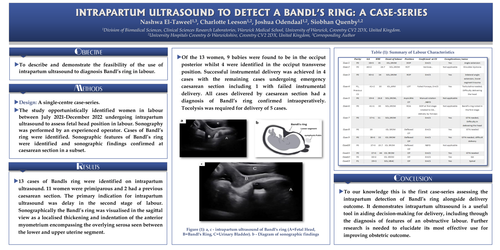
Results: 13 cases of Bandls ring were identified on intrapartum ultrasound. 11 women were primiparous and 2 had a previous caesarean section. The primary indication for intrapartum ultrasound was delay in the second stage of labour. Sonographically the Bandl’s ring was visualised in the sagittal view as a localised thickening and indentation of the anterior myometrium encompassing the overlying serosa seen between the lower and upper uterine segment.
Of the 13 women, 9 babies were found to be in the occiput posterior whilst 4 were identified in the occiput transverse position. Successful instrumental delivery was achieved in 4 cases with the remaining cases undergoing emergency caesarean section including 1 with failed instrumental delivery. All cases delivered by caesarean section had a diagnosis of Bandl’s ring confirmed intraoperatively. Tocolysis was required for delivery of 5 cases.
Conclusion:
To our knowledge this is the first case-series assessing the intrapartum detection of Bandl’s ring alongside delivery outcome. It demonstrates intrapartum ultrasound is a useful tool in aiding decision-making for delivery, including through the diagnosis of features of an obstructive labour. Further research is needed to elucidate its most effective use for improving obstetric outcome.