1,830 posters, 67 videos, 75 audios, 29 topics, 22 sessions, 4,727 authors, 1,697 institutions
ePostersLive by SciGen Technologies S.A. All rights reserved.
RCOG World Congress 2023
June 12 - 14, 2023 | London, UK

EP.1559
A case report of a viable pregnancy associated with suboptimal bHCG rise
Poster Presenter
Part of Topic
Early Pregnancy Complications and Gynaecology
A case report of a viable pregnancy associated with suboptimal bHCG rise
Joana Almeida1,2, Shefali Rathee1, Manju Singh1
1Department of Obstetrics and Gynaecology, Doncaster & Bassetlaw Teaching Hospitals NHS Foundation Trust
2Sheffield Teaching Hospitals NHS Foundation Trust
Background:
Human chorionic gonadotrophin is a glycoprotein which contains a ⍺ subunit and a single β-subunit which is unique, and distinguishes it from the other glycoprotein hormones. The free β-hCG circulating in maternal serum corresponds to only about 0.3–4 % of the total hCG. It is synthesized by villous syncytiotrophoblastic and trophoblastic cells and has multiple functions, namely:
Current literature supports that an increase in serum βhcg levels above 63% over 48 hours are likely associated with viable intrauterine pregnancies. On the opposite, a drop greater than 50% is suggestive of a failing pregnancy. Suboptimal rises or drops raise the suspicion of ectopic and/or failing pregnancy.
Objectives:
To report a case of suboptimal increase in hCG levels in early pregnancy in a viable intrauterine pregnancy and to demonstrate the limitations of serum hCG measurements as a method of tracking early pregnancies.
Case report:
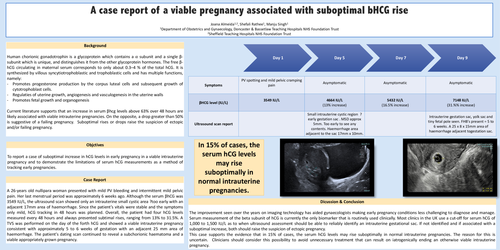
A 26-years old nullipara woman presented with mild PV bleeding and intermittent mild pelvic pain. Her last menstrual period was approximately 6 weeks ago. Although the serum βhCG was 3549 IU/L, the ultrasound scan showed only an intrauterine small cystic area ?too early with an adjacent 17mm area of haemorrhage. Since the patient’s vitals were stable and the symptoms only mild, hCG tracking in 48 hours was planned. Overall, the patient had four hCG levels measured every 48 hours and always presented subtimal rises, ranging from 13% to 31.5%. A TVS was performed on the day of the forth hCG and showed a viable intrauterine pregnancy consistent with approximately 5 to 6 weeks of gestation with an adjacent 25 mm area of haemorrhage. The patient's dating scan continued to reveal a subchorionic haematoma and a viable appropriately grown pregnancy.
Discussion & Conclusion:
The improvement seen over the years on imaging technology has aided gynaecologists making early pregnancy conditions less challenging to diagnose and manage. Serum measurement of the beta subunit of hCG is currently the only biomarker that is routinely used clinically. Most clinics in the UK use a cut-off for serum hCG of 1,000 to 1,500 IU/L as to when ultrasound assessment should be able to reliably identify an intrauterine gestational sac. If not identified and if associated with a suboptimal increase, both should raise the suspicion of ectopic pregnancy.
This case supports the evidence that in 15% of cases, the serum hCG levels may rise suboptimally in normal intrauterine pregnancies. The reason for this is uncertain. Clinicians should consider this possibility to avoid unnecessary treatment that can result on iatrogenically ending an otherwise viable intrauterine pregnancy.