1,830 posters, 67 videos, 75 audios, 29 topics, 22 sessions, 4,727 authors, 1,697 institutions
ePostersLive by SciGen Technologies S.A. All rights reserved.
RCOG World Congress 2023
June 12 - 14, 2023 | London, UK

EP.1482
Pregnancy of Unknown Location Rates: Good Performance Indicators for Early Pregnancy Units?
Poster Presenter
Authors
Affiliations
Part of Topic
Early Pregnancy Complications and Gynaecology
Pregnancy of unknown location rates: Good Performance Indicators for Early Pregnancy Units?
Dr Aimee Griffiths, Dr Hend Hadawi, Ms Sukhy Bhullar and Mr Gabriel Awadzi
Background
Pregnancy of Unknown Location (PUL) describes a situation of positive pregnancy test in the absence of definitive visualization of pregnancy upon ultrasound scan (1). Low risk outcomes occur in 70% of all PUL and include failed PUL or intrauterine pregnancy (IUP) (2). Alternatively, there may be high risk outcome PUL such as persistent PUL or (in up to 20% of PUL cases) invisible ectopic pregnancies (3). Quality of ultrasound machine and sonographers experience influences the prevalence of PUL in any given centre. It is crucial to follow up patients with PUL until the location of the pregnancy is defined. (4)
Objective
This audit was undertaken to assess Darent Valley Hospital’s Early Pregnancy Unit (DVH EPU) practice in diagnosis, management and follow up of PUL against local protocol and national guidelines as well as latest evidence - 2 stage triage and M6 model.
Design
A retrospective audit at Darent Valley Hospital from 01st Jan to 30th April 2021.
Method
100 patients were given a provisional diagnosis of PUL. 59 patients were excluded for not meeting inclusion criteria (beta-human chorionic gonadotropin [BHCG] greater than 20, ultrasound scan undertaken, positive pregnancy test). 41 patients were analysed. Total Number of scans during audit period was 139.
Results
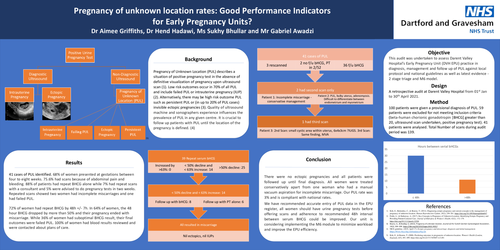
41 cases of PUL identified. 68% of women presented at gestations between four to eight weeks. 75.6% had scans because of abdominal pain and bleeding. 88% of patients had repeat BHCG alone while 7% had repeat scans with a consultant and 5% were advised to do pregnancy tests in two weeks. Repeated scans showed two women had incomplete miscarriages and one had failed PUL.
72% of women had repeat BHCG by 48h +/- 7h. In 64% of women, the 48 hour BHCG dropped by more than 50% and their pregnancy ended with miscarriage. While 36% of women had suboptimal BHCG result, their final outcomes were failed PUL. 100% of women had blood results reviewed and were contacted about plans of care.
Conclusion
There were no ectopic pregnancies and all patients were followed up until final diagnosis. All women were treated conservatively apart from one woman who had a manual vacuum aspiration for incomplete miscarriage. Our PUL rate was 3% and is compliant with national rates.
We have recommended accurate entry of PUL data in the EPU register, all women should have urine pregnancy tests before offering scans and adherence to recommended 48h interval between serum BHCG could be improved. Our unit is considering implementing the M6 module to minimize workload and improve the EPU efficiency.