1,830 posters, 67 videos, 75 audios, 29 topics, 22 sessions, 4,727 authors, 1,697 institutions
ePostersLive by SciGen Technologies S.A. All rights reserved.
RCOG World Congress 2023
June 12 - 14, 2023 | London, UK

EP.1477
Diagnosis and Management of Ectopic Pregnancy in the Early Pregnancy Unit
Poster Presenter
Authors
Sasha Ang, Hassan Shehata, Emma Doherty, Asli Ucyigit, Nadia Amokrane
Affiliations
Part of Topic
Early Pregnancy Complications and Gynaecology
Ectopic Pregnancy in Epsom and St Helier Hospital: An Audit of Diagnosis and Management
Sasha Ang, Hassan Shehata, Emma Doherty, Asli Ucyigit, Nadia Amokrane
-
An ectopic pregnancy is defined as any pregnancy implanted outside of the endometrial cavity
-
The incidence is 11/1000 pregnancies in the UK
-
withanestimated11000 ectopic pregnancies diagnosed each year
-
The incidence of ectopic pregnancy in women attending early pregnancy units is 2–3%
-
Risk factors include tubal damage following surgery or infection, smoking and IVF
Aims:
-
To audit the diagnosis and management of ectopic pregnancies in the Early Pregnancy Unit (EPU) in Epsom and St Helier University Hospitals
-
To compare our management against the auditable standards listed in the RCOG Greentop Guideline 21 for Ectopic Pregnancy
-
All women with an ultrasound scan diagnosis of ectopic pregnancy or ectopic pregnancy diagnosed at laparoscopy from January to December 2022 were retrospectively identified from electronic records in Epsom and St Helier Early Pregnancy Units and theatre records
-
The management of all cases were assessed against
auditable standards listed in the RCOG Greentop Guideline 21 for Ectopic Pregnancy
-
Data was collected on Excel, analysed and checked by 2 doctors
Results:
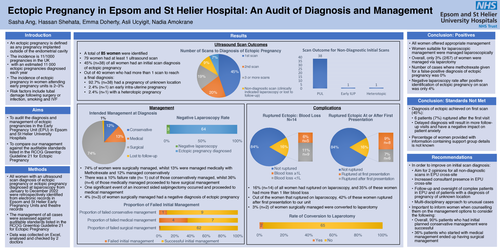
Ultrasound Scan Outcomes:
-
A total of 85 women were identified
-
79 women had at least 1 ultrasound scan
-
45% (n=38) of all women had an initial scan diagnosis
of ectopic pregnancy
-
Out of 40 women who had more than 1 scan to reach
a final diagnosis:
-
92.7% (n=38) had a pregnancy of unknown location
-
2.4% (n=1) an early intra-uterine pregnancy
-
2.4% (n=1) with a heterotopic pregnancy
-
74% of women were surgically managed, whilst 13% were managed medically with Methotrexate and 12% managed conservatively
-
There was a 10% failure rate (n= 1) out of those conservatively managed, whilst 36% (n=4) of those medically managed proceeded to have surgical management
-
One significant event of an incorrect sided salpingectomy occurred and proceeded to medical management
-
4% (n=3) of women surgically managed had a negative diagnosis of ectopic pregnancy
Complications:
-
16% (n=14) of all women had ruptured on laparoscopy, and 35% of these women had more than 1 liter blood loss
-
Out of the women that ruptured on laparoscopy, 42% of these women ruptured after first presentation to our unit
-
3% (n=2) of women surgically managed were converted to laparotomy
-
All women offered appropriate management
-
Women suitable for laparoscopic management were managed laparoscopically
-
Overall, only 3% (2/67) of women were managed via laparotomy
-
Number of cases where methotrexate given for a false-positive diagnosis of ectopic pregnancy was 0%
-
Negative laparoscopy rate after positive identification of ectopic pregnancy on scan was only 4%
-
Diagnosis of ectopic achieved on first scan (45%):
• 6 patients (7%) ruptured after the first visit
• Delayed diagnosis will result in more follow- up visits and have a negative impact on patient anxiety
-
Percentage of women provided with information containing support group details is not known
-
In order to improve on initial scan diagnosis:
-
Aim for 2 opinions for all non-diagnostic scans in EPU cross-site
-
Increased consultant presence in EPU cross-site
-
Follow-up and oversight of complex patients in EPU and of patients with a diagnosis of pregnancy of unknown location
-
Multi-disciplinary approach to unusual cases
-
-
Important to inform women when counselling them on the management options to consider the following:
-
Overall, 90% patients who had initial planned conservative management were successful
-
36% patients who started with medical management ended up having surgical management
-