1,830 posters, 67 videos, 75 audios, 29 topics, 22 sessions, 4,727 authors, 1,697 institutions
ePostersLive by SciGen Technologies S.A. All rights reserved.
RCOG World Congress 2023
June 12 - 14, 2023 | London, UK

EP.1451
Laparoscopic promontofixation in the management of pelvic organ prolapse.
Poster Presenter
Part of Topic
Urogynaecology/Pelvic Floor
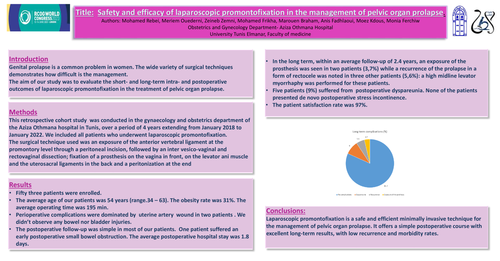
Title: Safety and efficacy of laparoscopic promontofixation in the management of pelvic organ prolapse.
Authors: Mohamed Rebei, Meriem Ouederni, Zeineb Zemni, Mohamed Frikha, Marouen Braham, Anis Fadhlaoui, Moez Kdous, Monia Ferchiw
Obstetrics and Gynecology Department- Aziza Othmana Hospital
University Tunis Elmanar, Faculty of medicine
Introduction
Genital prolapse is a common problem in women. The wide variety of surgical techniques demonstrates how difficult the management is.
The aim of our study was to evaluate the short- and long-term intra- and postoperative outcomes of laparoscopic promontofixation in the treatment of pelvic organ prolapse.
Methods
This retrospective cohort study was conducted in the gynaecology and obstetrics department of the Aziza Othmana hospital in Tunis, over a period of 4 years extending from January 2018 to January 2022. We included all patients who underwent laparoscopic promontofixation.
The surgical technique used was an exposure of the anterior vertebral ligament at the promontory level through a peritoneal incision, followed by an inter vesico-vaginal and rectovaginal dissection; fixation of a prosthesis on the vagina in front, on the levator ani muscle and the uterosacral ligaments in the back and a peritonization at the end.
Results
• Fifty three patients were enrolled.
• The average age of our patients was 54 years (range.34 – 63). The obesity rate was 31%. The average operating time was 195 min.
• Perioperative complications were dominated by uterine artery wound in two patients. We didn’t observe any bowel nor bladder injuries.
• The postoperative follow-up was simple in most of our patients. One patient suffered an early postoperative small bowel obstruction. The average postoperative hospital stay was 1.8 days.
• In the long term, within an average follow-up of 2.4 years, an exposure of the prosthesis was seen in two patients (3, 7%) while a recurrence of the prolapse in a form of rectocele was noted in three other patients (5, 6%): a high midline levator myorrhaphy was performed for these patients.
• Five patients (9%) suffered from postoperative dyspareunia. None of the patients presented de novo postoperative stress incontinence.
• The patient satisfaction rate was 97%.
• Conclusions:
• Laparoscopic promontofixation is a safe and efficient minimally invasive technique for the management of pelvic organ prolapse. It offers a simple postoperative course with excellent long-term results, with low recurrence and morbidity rates.