1,830 posters, 67 videos, 75 audios, 29 topics, 22 sessions, 4,727 authors, 1,697 institutions
ePostersLive by SciGen Technologies S.A. All rights reserved.
RCOG World Congress 2023
June 12 - 14, 2023 | London, UK

EP.1440
Ruptured corpus luteum causing 1.2 L haemoperitoneum alongside an ongoing intrauterine pregnancy
Poster Presenter
Authors
Affiliations
Part of Topic
Early Pregnancy Complications and Gynaecology
Ruptured corpus luteum causing 1.2 L haemoperitoneum alongside an ongoing intrauterine pregnancy: A case report and literature review
Dr. Coreen Soh, Miss Parynaaz Fardoom, Miss Reem Nasur
Blackpool Victoria Hospital
Introduction
Haemoperitoneum is the accumulation of blood in the pelvic cavity causing peritoneal irritation symptoms such as nausea, vomiting, abdominal pain, and dizziness1. There are several gynaecological causes of haemoperitoneum including ruptured ectopic pregnancy, ovarian tumours eg. endometrioma, and deep infiltrating endometriosis. The rupture of a functional ovarian cyst, such as a corpus luteum cyst, can occur both in patients with coagulopathies and healthy individuals2. Rupture can occur at any age between menarche and menopause, however is most commonly seen in the third decade of life3. Though functional cysts can rupture without producing symptoms, around 4% of women will be admitted to hospital for ovarian cysts by the age of 654. Cysts larger than 3cm are associated with an increased incidence of rupture5.
Ultrasound is the imaging modality of choice for the initial evaluation of a patient with an acute abdomen, especially if the cause is suspected to be gynaecological in origin, with transabdominal and transvaginal scans being preferred6. Contrast CT may be performed in cases where bHCG is negative and non-gynaecological causes are suspected, however may also be considered in suspected or confirmed intrauterine pregnancy if the USS is non-diagnostic and MRI is unavailable for prompt diagnosis of a life-threatening condition7.
Case Presentation
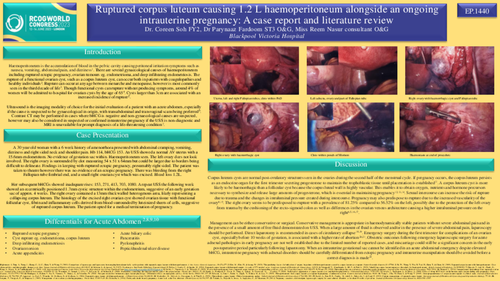
A 30 year old woman with a 6 week history of amenorrhoea presented with abdominal cramping, vomiting, dizziness and right sided neck and shoulder pain. Hb 114, bHCG 153. An USS showed a normal AV uterus with a 15.6mm endometrium. No evidence of gestation sac within. Haemoperitoneum seen. The left ovary does not look involved. The right ovary is surrounded by clot measuring 54 x 51 x 64mm but could be larger due to borders being difficult to delineate. Findings in keeping with ruptured ectopic pregnancy, presumably right sided. The patient was taken to theatre however there was no evidence of an ectopic pregnancy. There was bleeding from the right Fallopian tube fimbrial end, and a small right ovarian cyst which was excised. Blood loss 1.2L.
Her subsequent bHCGs showed inadequate rises: 153, 271, 413, 703, 1080. A repeat USS the following week showed an eccentrically positioned 1.7mm cystic structure within the endometrium, suggestive of an early gestation sac of approx. 4 weeks. The right ovary contained a 13mm thick walled heterogenous area, likely representing a collapsing corpus luteum. The histology of the excised right ovarian cyst showed ovarian tissue with functional follicular cyst, fibrin and inflammatory cells derived from blood surrounded by luteinized sheets of cells, suggestive of ruptured corpus luteum. The patient opted for a medical termination of pregnancy.
Differential Diagnosis
Discussion
Corpus luteum cysts are normal post-ovulatory structures seen in the ovaries during the second half of the menstrual cycle. If pregnancy occurs, the corpus luteum persists as an endocrine organ for the first trimester secreting progesterone to maintain the trophoblastic tissue until placentation is established11. A corpus luteum cyst is more likely to be haemorrhagic than a follicular cyst because the corpus luteal wall is highly vascular. This enables it to obtain oxygen, nutrients and hormone precursors necessary to synthesize and release large amounts of progesterone, which is essential in maintaining pregnancy12,13,14. Sexual intercourse can increase the risk of rupture due to trauma and the changes in intraluminal pressure created during intercourse. Pregnancy may also predispose to rupture due to the increased vascularity of the ovary8,15. The right ovary seems to be predisposed to rupture with a prevalence of 81.25% compared to 56.52% on the left, possibly due to the protection of the left ovary from trauma by the cushioning of the recto-sigmoid colon as well as differences in the ovarian venous architecture causing a higher intraluminal pressure on the right4,5,16,17.
Management can be either conservative or surgical. Conservative management is appropriate in haemodynamically stable patients without severe abdominal pain and in the presence of a small amount of free fluid demonstrated on USS. When a large amount of fluid is observed and/or in the presence of severe abdominal pain, laparoscopy should be performed. Direct laparotomy is recommended in cases of circulatory collapse18,19. Emergency surgery during the first trimester for complications of an ovarian cyst, especially before 10 weeks of gestation, is associated with a higher rate of abortion20,21. Obstetric outcomes following emergency laparoscopic surgery for acute adnexal pathologies in early pregnancy are not well established due to the limited number of reported cases, and miscarriage could still be a significant concern in the early postoperative period particularly following laparotomy. When an intrauterine gestational sac cannot be identified in an acute abdominal emergency despite elevated bHCG, intrauterine pregnancy with adnexal disorders should be carefully differentiated from ectopic pregnancy and intrauterine manipulation should be avoided before a correct diagnosis is made22.
References:
1. Teng, S., Tseng, J., Chang, C., Li, C., Chen, Y., & Wang, P. (2003). Comparison of laparoscopy and laparotomy in managing hemodynamically stable patients with ruptured corpus luteum with hemoperitoneum. J. Am. Assoc. Gynecol. Laparosc., 10:474-477.
2. Kim, M., Kim, H., & Seong, W. (2021). The predicting factors for indication of surgery in patients with hemoperitoneum caused by corpus luteum cyst rupture. Nature Scientific Reports, 11:17766.
3. Ho, W., Wang, Y., Wu, H., Tsai, H., Chen, T., & Chen, M. (2009). Ruptured corpus luteum with hemoperitoneum: Case characteristics and demographic changes over time. Taiwan Journal of Obstetrics & Gynecology, 48:108-12.
4. Mobeen, S., & Apostol, R. (2022). Ovarian cyst. StatPearls Publishing Treasure Island.
5. Hallatt, J., Steele, C., & Snyder, M. (1984). Ruptured corpus luteum with hemoperitoneum: A study of 173 surgical cases. American Journal of Obstetrics & Gynaecology, 149:5-9.
6. Pulappadi, V., Manchanda, S., SK, P., & Hari, S. (2021). Identifying corpus luteum rupture as the culprit for haemoperitoneum. British Journal of Radiology, 94:20200383.
7. Bhosale, P., Atri, M., Harris, R., Kang, S., Meyer, B., & Pandharipande, P. (2015). ACR Appropriateness Criteria: Acute Pelvic Pain in the Reproductive Age Group. Retrieved from https://acsearch.acr.org/docs/69503/Narrative/
8. Belsky, J., Nagarwala, J., & Tokarski, G. (2015). Massive hemoperitoneum from a ruptured corpus luteum cyst masquerading as biliary colic. Int J Case Rep Images, 6(3):168-172.
9. Waters, H. (1918). Hemorrhage into an ovarian cyst simulating ectopic pregnancy. Journal of the American Medical Association, 70(5)295-6.
10. Phaneuf, L. (1924). Intraperitoneal hemorrhage from ruptured ovarian cyst. Journal of the American Medical Association, 83(9)658-62.
11. Niswender, G., Juengel, J., Silva, P., Rollyson, M., & McIntush, E. (2000). Mechanisms controlling the function and life span of the corpus luteum. Physiol Rev, 80(1):1-29.
12. Bonde, A., Korngold, E., Foster, B., Fung, A., Sohaey, R., Pettersson, D., . . . Coakley, F. (2016). Radiological appearances of corpus luteum cysts and their imaging mimics. Abdominal Radiology, 2270-2282.
13. Jarvela, I., Ruokonen, A., & Tekay, A. (2008). Effect of rising hCG levels on the human corpus luteum during early pregnancy. Hum. Reprod., 23(12):2775-2781.
14. Henriquez, S., Kohen, P., Xu, X., Veenstra, T., Munoz, A., & Palomino, W. (2016). Estrogen metabolites in human corpus luteum physiology: Differential effects on angiogenic activity. Fertil. Steril., 106(1):230-237.
15. Babacan, A., Gun, I., Bodur, S., Akpak, Y., Muhcu, M., & Atay, V. (2015). Hemoperitoneum from corpus luteum cyst rupture in pregnancy of unknown location. Eastern Journal of Medicine, 58-61.
16. Tang, L., Cho, H., Chan, S., & Wong, V. (1985). Dextropreponderance of corpus luteum rupture: A clinical study. Journal of Reproductive Medicine, 30:764-768.
17. Aggarwal, A., Goel, P., Wanchu, M., Malhotra, R., & Malhotra, S. (2004). Ruptured corpus luteum with hemoperitoneum. J Obstet Gynecol Ind, 54:488-90.
18. Medvediev, M., Malvasi, A., Gustapane, S., & Tinelli, A. (2020). Hemorrhagic corpus luteum: Clinical management update. Turkish Journal of Obstetrics & Gynecology, 17(4):300-309.
19. Raziel, A., Ron-El, R., Pansky, M., Arieli, S., Bukovsky, I., & Caspi, E. (1993). Current management of ruptured corpus luteum. European Journal of Obstetrics & Gynecology and Reproductive Biology, 77-81.
20. Sergent, F., Verspyck, E., & Marpeau, L. (2003). Management of an ovarian cyst during pregnancy. Presse Med, 32:1039-45.
21. Goldstein, S. (1994). Embryonic death in early pregnancy: A new look at the first trimester. Obstet Gynecol, 84:294-297.
22. Takeda, A., Hayashi, S., Imoto, S., Sugiyama, C., & Nakamura, H. (2014). Pregnancy outcomes after emergent laparoscopic surgery for acute adnexal disorders at less than 10 weeks of gestation. Journal of Obstetrics & Gynaecology Research, 40(5):1281-1287.