1,830 posters, 67 videos, 75 audios, 29 topics, 22 sessions, 4,727 authors, 1,697 institutions
ePostersLive by SciGen Technologies S.A. All rights reserved.
RCOG World Congress 2023
June 12 - 14, 2023 | London, UK

EP.1399
Laparoscopic Management of Scar Ectopic Pregnancy: Case Report
Poster Presenter
Part of Topic
Early Pregnancy Complications and Gynaecology
Laparoscopic Management of Scar Ectopic Pregnancy: Case Report
Pokharel A, Biervliet F, Al-Dujaily A, Maydanovych S
Hull University Teaching Hospitals NHS Trust
Objective
Scar ectopic pregnancy (implantation into the myometrial defect at the site of previous uterine incision) is rare with an incidence of around 1 in 2000 pregnancies.1 It can be a diagnostic challenge and even if diagnosed in time, there is no sufficient evidence to recommend one intervention over the other. Hence treatment modalities are guided by the experience of the treating gynaecologist. We present a case of a scar ectopic pregnancy which was treated with laparoscopic resection and repair, four and half months after diagnosis and after failed medical management with methotrexate.
Case report
A 25 year old morbidly obese (BMI 52) G3P2 (having had two previous cesarean sections), presented to our centre for second opinion due to persistent lower abdominal cramps for about 5 months. She was diagnosed to have scar ectopic pregnancy with trophoblast into the niche at 5 weeks gestation with an ultrasound scan and confirmed by MRI pelvis done 4 and half months earlier (30/06/22) at another centre where she was initially managed conservatively as her serum beta hcg fell down rapidly from 66,315 IU/L to 292 IU/L after which it plateaued. Thence, she had received injection methotrexate (05/09/22) following which serum beta hcg dropped to 72 IU/L (11/08/22) and plateaued again.
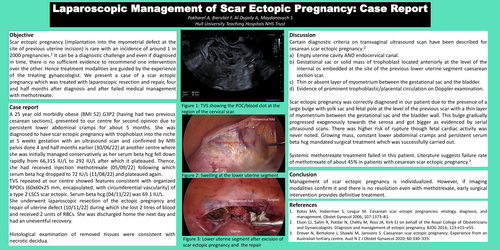
TVS repeated at our centre showed features consistent with organized RPOCs (60x60x25 mm, encapsulated, with circumferential vascularity) of a type 2 LSCS scar ectopic. Serum beta hcg (04/11/22) was 69.1 IU/L.
She underwent laparoscopic resection of the ectopic pregnancy and repair of uterine defect (10/11/22) during which she lost 2 litres of blood and received 2 units of RBCs. She was discharged home the next day and had an uneventful recovery.
Histological examination of removed tissues were consistent with necrotic decidua.
Discussion
Certain diagnostic criteria on transvaginal ultrasound scan have been described for cesarean scar ectopic pregnancy:2
Scar ectopic pregnancy was correctly diagnosed in our patient due to the presence of a large bulge with yolk sac and fetal pole at the level of the previous scar with a thin layer of myometrium between the gestational sac and the bladder wall. This bulge gradually progressed exogenously towards the serosa and got bigger as evidenced by serial ultrasound scans. There was higher risk of rupture though fetal cardiac activity was never noted. Growing mass, constant lower abdominal cramps and persistent serum beta hcg mandated surgical treatment which was successfully carried out.
Systemic methotrexate treatment failed in this patient. Literature suggests failure rate of methotrexate of about 45% in patients with cesarean scar ectopic pregnancy.3
Conclusion
Management of scar ectopic pregnancy is individualized. However, if imaging modalities confirm it and there is no resolution even with methotrexate, early surgical intervention provides definitive treatment.
References