1,830 posters, 67 videos, 75 audios, 29 topics, 22 sessions, 4,727 authors, 1,697 institutions
ePostersLive by SciGen Technologies S.A. All rights reserved.
RCOG World Congress 2023
June 12 - 14, 2023 | London, UK

EP.1378
Heterotopic Pregnancy After Natural Conception: A Case Study
Poster Presenter
Authors
Affiliations
Part of Topic
Early Pregnancy Complications and Gynaecology
Heterotopic Pregnancy After Natural Conception A Case Study
Dr. Joseph Murphy, GP Obstetrician, Young District Hospital, NSW, Australia
Dr. Arturo Jeri, GP Obstetrician, Temora District Hospital, NSW, Australia
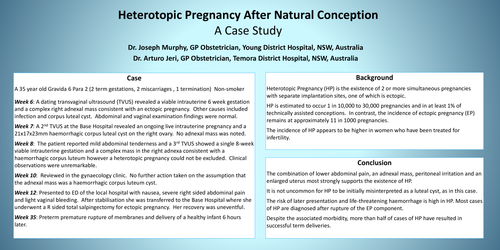
Case A 35 year old Gravida 6 Para 2 (2 term gestations, 2 miscarriages , 1 termination) Non-smoker Week 6: A dating transvaginal ultrasound (TVUS) revealed a viable intrauterine 6 week gestation and a complex right adnexal mass consistent with an ectopic pregnancy. Other causes included infection and corpus luteal cyst. Abdominal and vaginal examination findings were normal. Week 7: A 2nd TVUS at the Base Hospital revealed an ongoing live intrauterine pregnancy and a 21x17x23mm haemorrhagic corpus luteal cyst on the right ovary. No adnexal mass was noted. Week 8: The patient reported mild abdominal tenderness and a 3 rd TVUS showed a single 8-week viable intrauterine gestation and a complex mass in the right adnexa consistent with a haemorrhagic corpus luteum however a heterotopic pregnancy could not be excluded. Clinical observations were unremarkable. Week 10: Reviewed in the gynaecology clinic. No further action taken on the assumption that the adnexal mass was a haemorrhagic corpus luteum cyst. Week 12: Presented to ED of the local hospital with nausea, severe right sided abdominal pain and light vaginal bleeding. After stabilisation she was transferred to the Base Hospital where she underwent a R sided total salpingectomy for ectopic pregnancy. Her recovery was uneventful. Week 35: Preterm premature rupture of membranes and delivery of a healthy infant 6 hours later.
Background Heterotopic Pregnancy (HP) is the existence of 2 or more simultaneous pregnancies with separate implantation sites, one of which is ectopic. HP is estimated to occur 1 in 10,000 to 30,000 pregnancies and in at least 1% of technically assisted conceptions. In contrast, the incidence of ectopic pregnancy (EP) remains at approximately 11 in 1000 pregnancies. The incidence of HP appears to be higher in women who have been treated for infertility
Conclusion The combination of lower abdominal pain, an adnexal mass, peritoneal irritation and an enlarged uterus most strongly supports the existence of HP. It is not uncommon for HP to be initially misinterpreted as a luteal cyst, as in this case. The risk of later presentation and life-threatening haemorrhage is high in HP. Most cases of HP are diagnosed after rupture of the EP component. Despite the associated morbidity, more than half of cases of HP have resulted in successful term deliveries