1,830 posters, 67 videos, 75 audios, 29 topics, 22 sessions, 4,727 authors, 1,697 institutions
ePostersLive by SciGen Technologies S.A. All rights reserved.
RCOG World Congress 2023
June 12 - 14, 2023 | London, UK

EP.1355
TWIN PREGNANCY COMPLICATED WITH COMPLETE HYDATIDIFORM MOLE AND COEXISTING LIVE FETUS.
Poster Presenter
Part of Topic
Early Pregnancy Complications and Gynaecology
TWIN PREGNANCY COMPLICATED WITH COMPLETE HYDATIDIFORM MOLE AND COEXISTING LIVE FETUS.
MMH Dissanayake1, WMAPB Walisundara1, SSN Chandrasiri2, Sharifdeen MS1
1District General Hospital Matale, Sri Lanka
2De Soyza Hospital for Women, Colombo, Sri Lanka
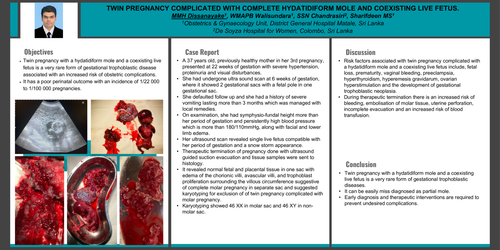
Objective: Twin pregnancy with a hydatidiform mole and a coexisting live fetus is a very rare form of gestational trophoblastic disease associated with an increased risk of obstetric complications. It has a poor perinatal outcome with an incidence of 1/22 000 to 1/100 000 pregnancies.
Case report: A 37 years old, previously healthy mother in her 3rd pregnancy, presented at 22 weeks of gestation with severe hypertension, proteinuria and visual disturbances. She had undergone ultra sound scan at 6 weeks of gestation, where it showed 2 gestational sacs with a fetal pole in one gestational sac. She defaulted follow up and she had a history of severe vomiting lasting more than 3 months which was managed with local remedies. On examination, she had symphysio-fundal height more than her period of gestation and persistently high blood pressure which is more than 180/110mmHg, along with facial and lower limb edema. Her ultrasound scan revealed single live fetus compatible with her period of gestation and a snow storm appearance. Therapeutic termination of pregnancy done with ultrasound guided suction evacuation and tissue samples were sent to histology. It revealed normal fetal and placental tissue in one sac with edema of the chorionic villi, avascular villi, and trophoblast proliferation surrounding the villous circumference suggestive of complete molar pregnancy in separate sac and suggested karyotyping for exclusion of of twin pregnancy complicated with molar pregnancy. Karyotyping showed 46 XX in molar sac and 46 XY in non-molar sac.
Discussion: Risk factors associated with twin pregnancy complicated with a hydatidiform mole and a coexisting live fetus include, fetal loss, prematurity, vaginal bleeding, preeclampsia, hyperthyroidism, hyperemesis gravidarum, ovarian hyperstimulation and the development of gestational trophoblastic neoplasia. During therapeutic termination there is an increased risk of bleeding, embolisation of molar tissue, uterine perforation, incomplete evacuation and an increased risk of blood transfusion.
Conclusion: Twin pregnancy with a hydatidiform mole and a coexisting live fetus is a very rare form of gestational trophoblastic diseases. Which can be easily miss diagnosed as partial mole. Early diagnosis and therapeutic interventions are required to prevent undesired complications.