1,830 posters, 67 videos, 75 audios, 29 topics, 22 sessions, 4,727 authors, 1,697 institutions
ePostersLive by SciGen Technologies S.A. All rights reserved.
RCOG World Congress 2023
June 12 - 14, 2023 | London, UK

EP.1275
CaseReport of Treatment of 3rd degree UV prolapse by Extended Mesh Pectopexy
Poster Presenter
Authors
Anupama Sethi Arora, Majed Shukri Alshurbasi, Pulkit Arora, Garima Mahajan
Affiliations
Part of Topic
Urogynaecology/Pelvic Floor
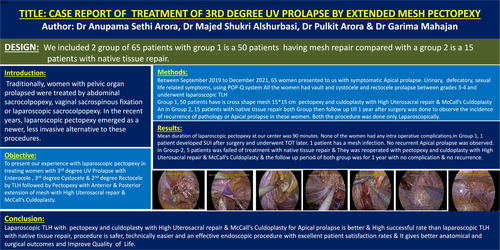
Title: CaseReport of Treatment of 3rd degree UV prolapse by Extended Mesh Pectopexy
Author: Dr Anupama Sethi Arora, Dr Majed Shukri Alshurbasi, Dr Pulkit Arora & Dr Garima Mahajan
Introduction:
Traditionally,women with pelvic organ prolapsed were treated by abdominal sacrocolpopexy, vaginal sacrospinous fixation or laparoscopic sacrocolpopexy. In the recent years, laparoscopic pectopexy emerged as a newer, less invasive alternative to these procedures.
Objective:
To present our experience with laparoscopic pectopexy in treating women with 3rd degree UV Prolapse with Enterocele , 3rd degree Cystocele & 2nd degree Rectocele by TLH followed by Pectopexy with Anterior & Posterior extension of mesh with High Uterosacral repair & McCall’s Culdoplasty.
DESIGN:
We included 2 group of 65 Patients with group 1 is a 50 patients having mesh repair compared with a group 2 is a 15 patients with native tissue repair.
Methods:
Between September 2019 to December 2021, 65 women presented to us with symptomatic Apical prolapse. Urinary, defecatory, sexual life related symptoms, using POP-Q system All the women had vault and cystocele and rectocele prolapse between grades 3-4 and underwent laparoscopic TLH
Group 1 50 patients have is cross shape mesh 15*15 cm pectopexy and culdoplasty with High Uterosacral repair & McCall’s Culdoplasty An in Group 2, 15 patients with native tissue repair both Group then follow up till 1 year after surgery was done to observe the incidence of recurrence of pathology or Apical prolapse in these women. Both the procedure was done only Laparoscopically.
Results:
Mean duration of laparoscopic pectopexy at our center was 90 minutes. None of the women had any intra operative complications.In Group-1, 1 patient developed SUI after surgery and underwent TOT later. 1 patient has a mesh infection. No recurrent Apical prolapse was observed. In Group-2, 5 patients was failed of treatment with native tissue repair & They was reoperated with pectopexy and culdoplasty with High Uterosacral repair & McCall’s Culdoplasty & the follow up period of both group was for 1 year with no complication & no recurrence.
Conclusion:
Laparoscopic TLH with pectopexy and culdoplasty with High Uterosacral repair & McCall’s Culdoplasty for Apical prolapse is better & High successful rate than laparoscopic TLH with native tissue repair, procedure is safer, technically easier and an effective endoscopic procedure with excellent patient satisfaction rates & It gives better anatomical and surgical outcomes and Improve Quality of Life.