1,830 posters, 67 videos, 75 audios, 29 topics, 22 sessions, 4,727 authors, 1,697 institutions
ePostersLive by SciGen Technologies S.A. All rights reserved.
RCOG World Congress 2023
June 12 - 14, 2023 | London, UK

EP.1236
Laparoscopy in pregnancy about 15 cases in a Tunisian University Hospital
Poster Presenter
Part of Topic
Early Pregnancy Complications and Gynaecology
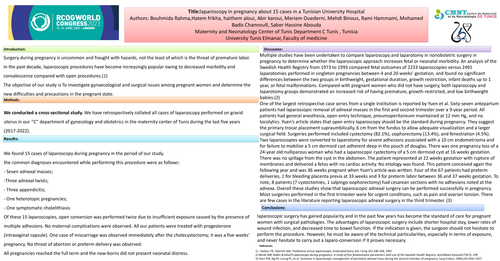
Title:laparoscopy in pregnancy about 15 cases in a Tunisian University Hospital Authors: Bouhmida Rahma,Hatem frikha, haithem aloui, Abir karoui, Meriem Ouederni, Mehdi Binous, Rami Hammami, Mohamed Badis Channoufi, Saber Hassine Abouda Maternity and Neonatology Center of Tunis Department C Tunis , Tunisia University Tunis Elmanar, Faculty of medicine
Introduction:
Surgery during pregnancy is uncommon and fraught with hazards, not the least of which is the threat of premature labor. In the past decade, laparoscopic procedures have become increasingly popular owing to decreased morbidity and convalescence compared with open procedures.(1) The objective of our study is To investigate gynaecological and surgical issues among pregnant women and determine the new difficulties and precautions in the pregnant state
Methods:
We conducted a cross-sectional study. We have retrospectively collated all cases of laparoscopy performed on gravid uterus in our ‘’C” department of gynecology and obstetrics in the maternity center of Tunis during the last five years (2017-2022)
Results:
We found 15 cases of laparoscopy during pregnancy in the period of our study. the common diagnoses encountered while performing this procedure were as follows: - Seven adnexal masses; -Three adnexal twists; - Three appendicitis; - One heterotopic pregnancies; - One symptomatic cholelithiasis. Of these 15 laparoscopies, open conversion was performed twice due to insufficient exposure caused by the presence of multiple adhesions. No maternal complications were observed. All our patients were treated with progesterone (intravaginal capsule). One case of miscarriage was observed immediately after the cholecystectomy; it was a five weeks’ pregnancy. No threat of abortion or preterm delivery was observed. All pregnancies reached the full term and the new-borns did not present neonatal distress.
Discussion:
Multiple studies have been undertaken to compare laparoscopy and laparotomy in nonobstetric surgery in pregnancy to determine whether the laparoscopic approach increases fetal or neonatal morbidity. An analysis of the Swedish Health Registry from 1973 to 1993 compared fetal outcomes of 2233 laparoscopies versus 2491 laparotomies performed in singleton pregnancies between 4 and 20 weeks’ gestation, and found no significant differences between the two groups in birthweight, gestational duration, growth restriction, infant deaths up to 1 year, or fetal malformations. Compared with pregnant women who did not have surgery, both laparoscopy and laparotomy groups demonstrated an increased risk of having premature, growth-restricted, and low birthweight babies.(2) One of the largest retrospective case series from a single institution is reported by Yuen et al. Sixty-seven antepartum patients had laparoscopic removal of adnexal masses in the first and second trimester over a 9-year period. All patients had general anesthesia, open entry technique, pneumoperitoneum maintained at 12 mm Hg, and no tocolytics. Yuen’s article states that open entry laparoscopy should be the standard during pregnancy. They suggest the primary trocar placement supraumbilically, 6 cm from the fundus to allow adequate visualization and a larger surgical field. Surgeries performed included cystectomy (82.1%), oophorectomy (13.4%), and fenestration (4.5%). Two laparoscopies were converted to laparotomy for severe adhesions associated with a 10 cm endometrioma and for failure to mobilize a 5 cm dermoid cyst adherent deep in the pouch of douglas. There was one pregnancy loss of a 24-year old nulliparous woman who had a laparoscopic cystectomy of a 5 cm dermoid cyst at 16 weeks gestation. There was no spillage from the cyst in the abdomen. The patient represented at 22 weeks gestation with rupture of membranes and delivered a fetus with no cardiac activity. No etiology was found. This patient conceived again the following year and was 36 weeks pregnant when Yuen’s article was written. Four of the 67 patients had preterm deliveries, 1 for bleeding placenta previa at 33 weeks and 3 for preterm labor between 36 and 37 weeks gestation. To note, 8 patients (7 cystectomies, 1 salpingo-oophorectomy) had cesarean sections with no adhesions noted at the adnexa. Overall these studies show that laparoscopic adnexal surgery can be performed successfully in pregnancy. Most surgeries performed in the first trimester were for urgent conditions, such as pain and ovarian torsion. There are few cases in the literature reporting laparoscopic adnexal surgery in the third trimester. (3)
Conclusions:
laparoscopic surgery has gained popularity and in the past few years has become the standard of care for pregnant women with surgical pathologies. The advantages of laparoscopic surgery include shorter hospital stay, lower rates of wound infection, and decreased time to bowel function. If the indication is given, the surgeon should not hesitate to perform the procedure. However, he must be aware of the technical particularities, especially in terms of exposure, and never hesitate to carry out a laparo-conversion if it proves necessary
Refrences:
1) . Gadacz TR, Talamini MA: Traditional versus laparoscopic cholecystectomy. Am J Surg 161:336-338, 1991
2) Reedy MB, Kallen B,nKuelTJ:aparoscopy during pregnancy: A study of five fetaloutcome parameters with use of the Swedish Health Registry. AmJObstet Gynecol177673, 199
3) Yuen PM, Ng PS, Leung PL, et al. Outcome in laparoscopic management of persistent adnexal mass during the second trimester of pregnancy. Surg Endosc. 2004;18:1354–1357.