1,830 posters, 67 videos, 75 audios, 29 topics, 22 sessions, 4,727 authors, 1,697 institutions
ePostersLive by SciGen Technologies S.A. All rights reserved.
RCOG World Congress 2023
June 12 - 14, 2023 | London, UK

EP.1216
Less intrusive abdominal wall organopexy surgery for stage III, IV genital prolapse
Poster Presenter
Authors
Affiliations
Part of Topic
Urogynaecology/Pelvic Floor
Less Intrusive abdominal wall Organopexy as surgical treatment for Stage III and IV genital prolapse.
Zulfiqar, Bushra1, Parveen, Shagufta1
1 Fatima Bai Hospital, Department of Gynae & Obs. Karachi, Pakistan
Abstract
Objective: To study the less intrusive abdominal wall organopexy (cervicopexy) as treatment of III and IV stage genital prolapse. Study Design: Observational Cross-sectional study. Method: 30 Patients of reproductive age group having stage III or IV genital prolapse assessed by POP-Q classification, and abdominal wall organopexy (cervicopexy) performed by affixing the cervix at internal OS to the rectus sheath using polypropylene sutures and uplift the anterior vaginal wall through abdominal wall route. Result: Out of total 30 patients, who had undergone abdominal wall organopexy (cervicopexy) for stage III or IV uterine prolapse, 20(66.6%) patients had 1-2 risk factors associated with their prolapse. Most common risk factor was multiparity found in 25(83.3%), while 18(60%) patients had history of heavy weightlifting along with multiparity. 12 (40%) patients were found with BMI in the range of 20 – 25,17 (56.67%) had BMI 25 – 30, while 1 (3.3%) patient had BMI >30. Recorded operating time in 23(76.6%) patients was found as 15-20min, while in 6(20%) patients it was 20-30min. Postoperatively, most of the patients i.e., 26(86.6%) had good and quick recovery except 4 patients (13.3%) who had postoperative pain relieved with good analgesics. Thereafter, 21(70%) patients found with the use of contraceptive method, while 9(30%) did not use any contraceptive methods. Out of 9 patients who tried for pregnancy, 2(6.6%) conceived and were delivered by cesarean section. No patient reported uterine prolapse recurrence after 2 years follow up and even after having pregnancy. The patients were further followed for around 2 years, 3 patients were lost after one year, however the rest of the 27 patients were satisfied throughout the process.
Conclusion: This altered surgical procedure of organopexy is less invasive, , easy, having minimal post-operative complications and potent solution for genital prolapse of stage III and IV .
Introduction
Uterine prolapse is a frequently occurring condition which comes across in Gynaecological practice and unfavorably affects the quality of life of a woman(1).It mainly effects post-menopausal women but may affect young women too, according to the risk factors and causes symptoms like sensation of something coming out of vagina, bulging mass into the vagina, urinary and fecal incontinence and complaining to digitate the vagina to urinate or defecate and sexual dysfunction (2,3).
Risk factors can be classified into congenital factors and acquired factors including multiple vaginal birth, heavy physical work, obesity, chronic cough, constipation, and malnutrition (4,5).
Many surgical treatments were performed by transvaginal or transabdominal approach in the patient. In spite of many surgical techniques, there is still no single method that is safe, effective, technically simple and has a short recovery and short learning curve (6). Now a days, surgeons are more concerned about their patient’s preference, impact on their quality of sexual life and psychological feeling associated with removing / saving the uterus (6). Consequently, the number of hysterectomies is declined in favor of uterus preserving surgeries (7).
Among all uterus preserving surgeries, anterior abdominal wall cervicopexy is a simple, easy and effective procedure for correction of stage III and IV POP (8,9). It is cheap, technically easy and has less operative time and less complication as compared to other procedures (10). It is an easy procedure and can be taught or performed easily to young gynaecologist in low-income countries.
So, our aim of study is to launch a new surgical technique for treatment of POP stage III and IV which is easy and effective.
Methods and material:
Study design: Observational Cross-sectional study
Target population: Patients with stage III and stage IV uterine prolapse.
Study setting: Fatimabai hospital Karachi
Duration of study: October 2019 till July 2022
Sampling technique: Non-Probability Sampling
Sample size: 30 women
Sample selection: Sample size was selected by convenient sampling technique.
Inclusion criteria: Women in reproductive age group with State III and Stage IV Uterine prolapse, wants to save their Uterus, no complain related to Urine incontinence and menstruation.
Exclusion criteria: Women with uterine prolapse and having concurrent menstrual problem, problem related to continence, any other compartmental prolapse or wants hysterectomy are excluded.
Data collection procedure:
After the concerned ethical committee’s approval, data of 30 patients of reproductive age group having stage III or IV uterine prolapse collected through outpatient department. POP-Q quantification system was used for assessing prolapse by points Aa, Ba, Ap, Bp, C and D measures and they were found on variable degrees in related to patients one another. Written consent was obtained after detailed counseling about benefits, alternate procedure and complications with the patients on whom abdominal wall organopexy (cervicopexy) performed by affixing the cervix at internal os to the rectus sheath using polypropylene sutures and uplift the anterior vaginal wall through abdominal wall route. The other types of surgery such as vaginal pessary and Sacro hysteropexy were discussed and the patients who agreed for Abdominal wall Cervicopexy were inducted in the study.
RESULT:
The mean age of the patients was 39 years 2 months, with a range of 30-45 years. All patients which came with complaint of something coming out from their vagina through vulva were married women with minor complaints like dragging sensation, dyspareunia, and vaginal discharge for which they had taken treatment. No patient had complained of urinary incontinence or any menstrual disorder.
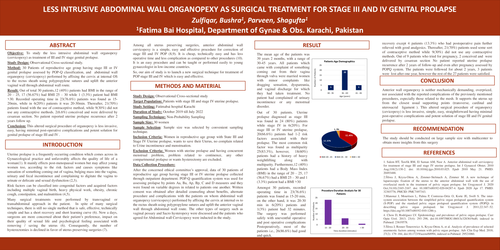
Out of 30 patients. Uterine prolapse diagnosed as stage III was found in 24 (80%) patients while stage IV in 6(20%). For stage III or IV uterine prolapse, 20(66.6%) patients had 1-2 risk factors associated with their prolapse. The most common risk factor was found as multiparity 25(83.3%), however, 18(60%) patients had a history of heavy weightlifting along with multiparity. Furthermore,12 (40%) patients had a Body Mass Index (BMI) in the range of 20 – 25, 17 (56.67%) had a BMI 25 – 30 and 1 (3.3%) patient had a BMI >30
Amongst 30 patients, recorded operating time in 23(76.6%) patients was found as 15-20 min, on the other hand, it was 20-30 min in 6(20%) patients and 1(3%) patient had 32 minutes. The surgery was performed safely with uneventful operative and post operative complications. Postoperatively, most of the patients i.e., 26(86.6%) had good and quick recovery except 4 patients (13.3%) who had postoperative pain further relieved with good analgesics. Thereafter, 21(70%) patients used some sort of contraceptive method while 9(30%) did not use any contraceptive methods. Out of 9 patients who tried for pregnancy, 2 conceived and were delivered by cesarean section. No patient reported uterine prolapse recurrence after 2 years of follow-up and even after pregnancy assessed by POPQ system.
The patients were followed for about 2 years, 3 patients were lost after one year, however the rest of the 27 patients were satisfied.
Conclusion: Anterior wall organopexy is neither mechanically demanding, overpriced, nor associated with the reported complications of the previously mentioned procedures, especially those related to the mesh. It supports the uterus up from the closest usual supporting points (transverse, cardinal and uterosacral ligament ). This altered surgical procedure of organopexy (cevicopexy) is less invasive, simple, easy, straightforward having minimal post-operative complications and potent solution of stage III and IV genital prolapse.
Recommendation; The study should be conducted on large sample size with multicenter to obtain more insights from this surgery
References:
- Salem HT, Tawfik RM, El Saman AM, Nasr A. Anterior abdominal wall cervicopexy for treatment of stage III and stage IV uterine prolapse. Int J Gynaecol Obstet. 2010 Aug;110(2):130-2. doi: 10.1016/j.ijgo.2010.03.025. Epub 2010 May 21. PMID: 20493488.
- Śliwa J, Kryza-Ottou A, Zimmer-Stelmach A, Zimmer M. A new technique of laparoscopic fixation of the uterus to the anterior abdominal wall with the use of overfascial mesh in the treatment of pelvic organ prolapse. Int Urogynecol J. 2020 Oct;31(10):2165-2167. doi: 10.1007/s00192-020-04287-4. Epub 2020 Apr 17. PMID: 32303776; PMCID: PMC7497343.
- Manonai J, Mouritsen L, Palma P, Contreras-Ortiz O, Korte JE, Swift S. The inter-system association between the simplified pelvic organ prolapsed quantification system (S-POP) and the standard pelvic organ prolapsed quantification system (POPQ) in describing pelvic organ prolapsed. Int Urogynecol J. 2011;22:347–52. https://doi.org/10.1007/s00192-010-1286-y.
- Chow D, Rodríguez LV. Epidemiology and prevalence of pelvic organ prolapse. Curr Opin Urol. 2013; 23(4): 293–298, doi:10.1097/MOU.0b013e3283619ed0, indexed in Pubmed: 23619578.
- Śliwa J, Rosner-Tenerowicz A, Kryza-Ottou A, et al. Analysis of prevalence of selected anamnestic factors among women with pelvic organ prolapse. Adv Clin Exp Med. 2018; 27(2): 179–184, doi:10.17219/acem/68994, indexed in Pubmed: 29521060.
- Sliwa J, Kryza-Ottou A, Grobelak J, Domagala Z, Zimmer M. Anterior abdominal fixation - a new option in the surgical treatment of pelvic organ prolapse. Ginekol Pol. 2021;92(7):471-474. doi: 10.5603/GP.a2021.0004. Epub 2021 Apr 12. PMID: 33844247.
- Śliwa J, Kryza-Ottou A, Zimmer-Stelmach A, et al. A new technique of laparoscopic fixation of the uterus to the anterior abdominal wall with the use of overfascial mesh in the treatment of pelvic organ prolapse. Int Urogynecol J. 2020; 31(10): 2165–2167, doi: 10.1007/s00192-020-04287-4, indexed in Pubmed: 32303776.
- Elsaman AM, Salem HT, Amin M, Fetih AN, Othman EE, Zahran KM. Modified cervicopexy: a novel, less-invasive technique for Stages III and IV uterine prolapse. Eur J Obstet Gynecol Reprod Biol. 2014 Dec;183:159-63. doi: 10.1016/j.ejogrb.2014.10.014. Epub 2014 Oct 23. PMID: 25461371.
- Salem HT, Tawfik RM, El Saman AM, Nasr A. Anterior abdominal wall cervicopexy for treatment of stage III and stage IV uterine prolapse. Int J Gynaecol Obstet 2010;110:130–2.
- Zyczynski HM, Carey MP, Smith AR, et al., Prosima Study Investigators. Oneyear clinical outcomes after prolapse surgery with nonanchored mesh and vaginal support device. Am J Obstet Gynecol 2010;203:587.e1–.e8.