Loading...

1,830 posters, 67 videos, 75 audios, 29 topics, 22 sessions, 4,727 authors, 1,697 institutions

ePostersLive by SciGen Technologies S.A. All rights reserved.

RCOG World Congress 2023

June 12 - 14, 2023 | London, UK

RCOG World Congress 2023 banner

EP.1179

Caesarean Scar Ectopic pregnancy - 11 years' experience
Part of Topic

Early Pregnancy Complications and Gynaecology

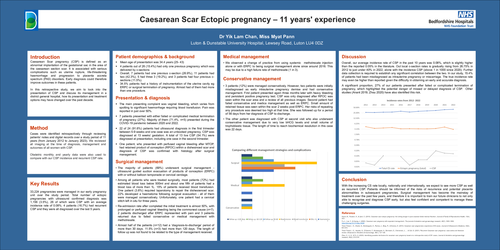
Caesarean Scar Ectopic pregnancy – 11 years' experience

Dr Yik Lam Chan, Miss Myat Pann. Luton & Dunstable University Hospital, Lewsey Road, Luton LU4 0DZ

Introduction

Caesarean Scar pregnancy (CSP) is defined as an abnormal implantation of the gestational sac in the area of the caesarean section scar. It is associated with serious complications such as uterine rupture, life-threatening haemorrhage and progression to placenta accreta spectrum (PAS) disorders. Early diagnosis could therefore improve outcomes in these patients. 


In this retrospective study, we aim to look into the presentation of CSP and discuss its management in a district general hospital, how its presentation and treatment options may have changed over the past decade. 


Method

Cases were identified retrospectively through reviewing patients’ notes and digital records over a study period of 11 years (from January 2012 to January 2023). We reviewed all imaging at the time of diagnosis, management and outcomes of all women with CSP.  

Obstetric monthly and yearly data were also used to compare with our CSP incidence and recurrent CSP rate.


Key Results

33,224 pregnancies were managed in our early pregnancy unit over the study period. Total number of ectopic pregnancies with ultrasound confirmed diagnosis was 1,156 (3.5%), 26 of which were CSP with an average incidence rate of 0.08%. 4 patients (16.7%) had recurrent CSP and they were all diagnosed over the last 5 years. 


Patient demographics & background

§Mean age of presentation was 34.4 years (25- 43)
§4 patients out of 26 (15.4%) had only one previous pregnancy which was delivered by c-sections
§Overall, 7 patients had one previous c-section (26.9%), 11 patients had two (42.3%), 5 had three 3 (19.2%), and 3 patients had four previous c-sections (11.5%). 
§34.5% patients had a history of instrumentation of the uterine cavity eg ERPC or surgical termination of pregnancy. Almost had of them had more than one procedure.
 

Presentation & diagnosis

§The main presenting complaint was vaginal bleeding, which varies from spotting to significant haemorrhage requiring blood transfusion. Pain was reported in just over 50%.
§7 patients presented with either failed or complicated medical termination of pregnancy (27%). Majority of them (71.4%, n=5) presented during the COVID-19 pandemic between 2020 and 2022. 
§22 of 24 (91.6%) patients had ultrasound diagnosis in the first trimester between 5-9 weeks and one case was an unbooked pregnancy, CSP was diagnosed at 13 weeks’ gestation. A total of 13 live CSP (54.1%) were diagnosed at presentation, including one case in the second trimester.
§One patient, who presented with perfused vaginal bleeding after MTOP, had retained product of conception (RPOC) within a dishesinced scar and diagnosis of CSP was confirmed with histology after surgical management.
 

Surgical management

•The majority of patients (69%) underwent surgical management - ultrasound guided suction evacuation of products of conception (ERPC) with or without balloon tamponade or cervical cerclage. 
•Among all patients who were treated surgically, most patients (72%) had estimated blood loss below 500ml and about one fifth of patients had a blood loss of more than 1L. 15% of patients received blood transfusion. One patient (3.8%) required laparotomy to repair the dishesienced scar. 22% developed a haematoma following surgical evacuation - all of them were managed conservatively. Unfortunately, one patient had a cervical stitch left in situ for three years. 
•Re-admission rate after completed the initial treatment is almost 50%, with prolonged or perfused vaginal bleeding being the commonest cause (n=7). 2 patients discharged after ERPC represented with pain and 3 patients returned due to failed conservative or medical management with methotrexate. 
•Almost half of the patients (n=12) had a ‘diagnosis-to-discharge’ period of more than 30 days. 11.5% (n=3) had more than 120 days. The length of follow up was not found to be related to the type of management received.


Medical management

•We observed a change of practice from using systemic  methotrexate injection alone or with ERPC to being surgical management alone since around 2016. This may be due to a high failure rate of methotrexate (1 in 3).

Conservative management

•3 patients (12%) were managed conservatively. However, two patients were initially misdiagnosed as early intrauterine pregnancy demise and had conservative management. First patient presented again three months later with heavy bleeding and persistent positive pregnancy test. CSP was only diagnosed after RPOC was seen within the scar area and a review of all previous images. Second patient had failed conservative and medica management as well as ERPC. Small amount of retained tissue was seen within the scar 2 weeks post ERPC. Her risks of repeating any procedure was deemed too high at that time. She was followed up for a period of 56 days from her diagnosis of CSP to discharge.
•The other patient was diagnosed with CSP at second visit who also underwent conservative management due to very low bHCG levels and small volume of trophoblastic tissue. The length of time to reach biochemical resolution in this case was 22 days.
 

Discussion

Overall, our average incidence rate of CSP in the past 10 years was 0.08%, which is slightly higher than the reported 0.05% in the literature. Out local c-section rates is gradually rising from 26.75% in 2012 to just under 40% in 2022, alone with the incidence CSP (above 1 in 1000 since 2020). Further data collection is required to establish any significant correlation between the two. In our study, 15.4% of patients had been misdiagnosed as intrauterine pregnancy or miscarriage. The true incidence rate may even be higher than reported given the difficulty in obtaining an early and accurate diagnosis.

A significant proportion, 27% of our patients presented after failed or complicated termination of pregnancy, which highlighted the potential danger of missed or delayed diagnosis of CSP.  Other studies (Anant 2019, Zhou 2020) have also identified this risk. 


Conclusion

With the increasing CS rate locally, nationally and internationally, we expect to see more CSP as well as recurrent CSP. Patients should be informed of the risks of recurrence and potential placenta abnormalities in subsequent pregnancies. Surgical management has become the mainstay of treatment over the past few years, and therefore it is important to train our future clinicians to not only able to recognise and diagnose CSP early, but also feel confident and competent to manage these challenging surgeries.


RCOG World Congress 2023 » banner
Copyright © 2015-2026, ePostersLive® SciGen is a registered trademark of SciGen Technologies S.A. Patent pending.

This website and third-party tools we use rely on cookies for the best user experience. By selecting "I agree", you agree to cookie usage as described in our Privacy Policy.