1,830 posters, 67 videos, 75 audios, 29 topics, 22 sessions, 4,727 authors, 1,697 institutions
ePostersLive by SciGen Technologies S.A. All rights reserved.
RCOG World Congress 2023
June 12 - 14, 2023 | London, UK

EP.1178
Developing a Gynaecology Same Day Emergency Care Service: Improving care for women
Poster Presenter
Part of Topic
Early Pregnancy Complications and Gynaecology
Developing a Gynaecology Same Day Emergency Care Service: Improving care for women
R Gisby, D Rampersad, V Croll, K Hayes, M Ghosh
AIM:
To improve care for women presenting to the Emergency Department (ED) with Hyperemesis Gravidarum (HG)
OBJECTIVES:
BACKGROUND:
METHOD:
We successfully applied for £18,973 of funding from Health Education England, to enable the acquisition and training of clinical staff to develop a Gynaecology SDEC unit, initially focussed on women with HG.
The development of the unit was over a 5 month period from January to May 2022, and it was subsequently launched to initially receive referrals directly from ED clinical staff.
MEASURES OF SUCCESS:
A reduction in the number of HG patients and length of stay seen in the ED
A reduction in the length of stay in ED and number of hospital admissions with HG
Availability of the SDEC unit – aiming for 12 hours a day, 7 days a week
RESULTS:
AVAILABILITY OF THE SERVICE
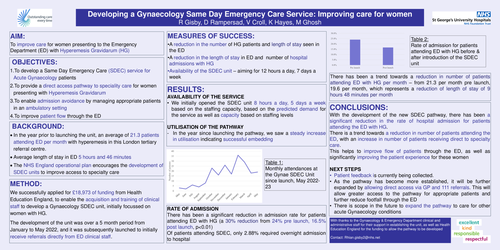
We initially opened the SDEC unit 8 hours a day, 5 days a week based on the staffing capacity, based on the predicted demand for the service as well as capacity based on staffing levels
UTILISATION OF THE PATHWAY
RATE OF ADMISSION
There has been a significant reduction in admission rate for patients attending ED with HG (a 30% reduction from 24% pre launch, 16.5% post launch, p<0.01)
Of patients attending SDEC, only 2.88% required overnight admission to hospital
There has been a trend towards a reduction in number of patients attending ED with HG per month – from 21.3 per month pre launch, 19.6 per month, which represents a reduction of length of stay of 9 hours 48 minutes per month
CONCLUSIONS:
With the development of the new SDEC pathway, there has been a significant reduction in the rate of hospital admission for patients attending the ED with HG.
There is a trend towards a reduction in number of patients attending the ED, with an increase in number of patients receiving direct to specialty care.
This helps to improve flow of patients through the ED, as well as significantly improving the patient experience for these women
NEXT STEPS
Patient feedback is currently being collected.
As the pathway has become more established, it will be further expanded by allowing direct access via GP and 111 referrals. This will allow greater access to the pathway for appropriate patients and further reduce footfall through the ED
There is scope in the future to expand the pathway to care for other acute Gynaecology conditions
With thanks to the Gynaecology & Emergency Department clinical and administrative staff for their support in establishing the unit, as well as Health Education England for the funding to allow the pathway to be developed
Contact: Rhian.gisby2@nhs.net