1,830 posters, 67 videos, 75 audios, 29 topics, 22 sessions, 4,727 authors, 1,697 institutions
ePostersLive by SciGen Technologies S.A. All rights reserved.
RCOG World Congress 2023
June 12 - 14, 2023 | London, UK

EP.1051
PERPLEXING DIAGNOSIS OF ACUTE ABDOMEN AND SUCCESSFUL MANAGEMENT
Poster Presenter
Part of Topic
Urogynaecology/Pelvic Floor
PERPLEXING DIAGNOSIS OF ACUTE ABDOMEN AND SUCCESSFUL MANAGEMENT
Authors:Beena Kumari.B,Mohamed Eraky, Abdul Rahman Omran,Khaled Sayed,Abeer Alzaydai,Obstetrics &Gynecology department, Adan Hospital, Kuwait.
MaherTalal Hassan,Department of General surgery,Adan Hospital,Kuwait
Ahmed S El-Abd, Department of urology,Adan Hospital,Kuwait
Introduction
Acute abdomen is known for its complex perplexing presentation. Prompt diagnosis& timely decision for surgical or conservative therapeutic measures is essential to reduce morbidity &mortality. Furthermore we should bear in mind that common surgical emergencies are known for their dubious presentations. Precise history &complete physical examination supplemented by blood investigations &imaging studies form a vital triad in the effective management of acute abdomen.
CASE REPORT
A 27 years old parous lady presented to emergency department with complaints anuria of one day and severe pain abdomen of 4 days duration. Prior to this complaint she was admitted in other hospital with complaints of headache, fever and stiff neck of 3 days duration, where CT Brain was done, which was normal and she had discharged against medical advice. No other medical or surgical history of significance.
On examination- Patient was semiconscious, Vitals – Afebrile, Pulse-126/min , BP-136/97mmHg.Per abdomen examination-Abdomen distended, guarding and rigidity was present suggestive of peritonitis. Bladder catheterized and drained 1 litre of clear urine. Resuscitation and investigations were started simultaneously. Clinically suspected as intestinal obstruction or perforation of bowel after ruling out pregnancy.
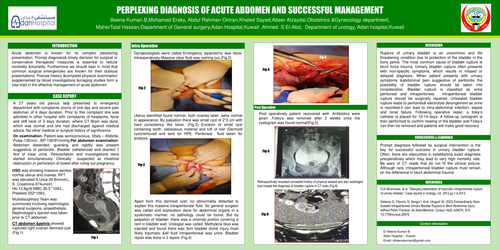
USG was showing massive ascites, normal uterus and ovaries.RFT was elevated-S.Urea-34.8mmol/L, S. Creatinine-874umol/l.Hb-13.8g/dl,WBC-30.5 *109/L, Platelets-552*109/L. Multidisciplinary Team was summoned involving nephrologist, general surgeons, anaesthetists. Nephrologist’s opinion was taken prior to CT abdomen. CT abdomen &pelvisshowed ruptured right ovarian dermoid cyst.So gynaecologists were called. Emergency laparotomy was done. Intraoperatively-Massive clear fluid was coming out.Uterus identified found normal, both ovaries seen ,were normal in appearance. By palpation there was small cyst of 2*2 cm with hard consistency like bone. Excision of small cyst containing tooth, sebaceous material and tuft of hair (Dermoid cyst)removed and sent for HPE. Peritoneal fluid taken for analysis.Apart from this dermoid cyst, no abnormality detected to explain this massive intraperitoneal fluid. So general surgeon was called and exploration done for abdominal organs in a systematic manner, no pathology could be found. But by palpation of bladder, there was a omental portion covering a rent in bladder wall. Urologist was called. Methylene blue was injected and found there was 3cm bladder dome injury most likely traumatic &all fluid intraperitoneal was urine. Bladder repair was done in 2 layers.Post operatively patient recovered well. Antibiotics were given .Foley’s was removed after 2 weeks once the cystogram was found normal. Retrospectively revealed concealed history of physical assault and also radiologist had missed the diagnosis of bladder rupture in CT scan.
Discussion: Rupture of urinary bladder is an uncommon and life threatening condition due to protection of the bladder in the bony pelvis. The most common cause of bladder rupture is blunt force trauma. Urinary bladder rupture often presents with non-specific symptoms, which results in missed or delayed diagnosis. When patient presents with urinary symptoms &abdominal pain suggestive of peritonitis the possibility of bladder rupture should be taken into consideration. Bladder rupture is classified as extra peritoneal and intraperitoneal. Intraperitoneal bladder rupture should be surgically repaired. Untreated bladder rupture leads to peritonitis& electrolyte derangement as urine is resorbed.It can lead to intra-abdominal infection, sepsis and renal failure. Following operative repair, a foley’s catheter is placed for 10-14 days. A follow-up cystogram is then performed to confirm healing of the bladder and Foley’s can then be removed and patients will make good recovery.
Conclusion: Prompt diagnosis followed by surgical intervention is the key for successful outcome in urinary bladder rupture. Often, there are obscurities in establishing exact diagnosis preoperatively which may lead to very high mortality rate. Be wary of CT reads that do not fit the clinical picture. Although rare, intraperitoneal bladder rupture must remain on the differential in blunt abdominal trauma.