1,830 posters, 67 videos, 75 audios, 29 topics, 22 sessions, 4,727 authors, 1,697 institutions
ePostersLive by SciGen Technologies S.A. All rights reserved.
RCOG World Congress 2023
June 12 - 14, 2023 | London, UK

EP.1046
Medical management of 1st-trimester miscarriage in the background of anticoagulation
Poster Presenter
Authors
Affiliations
Part of Topic
Early Pregnancy Complications and Gynaecology
Medical management of 1st-trimester miscarriage in the background of anticoagulation: A case report
Objective
Rheumatic heart disease is a huge burden to countries with emerging economies and the age-standardized prevalence is high in women of childbearing age. With the advancement of cardiac surgeries and anticoagulation, the rate of pregnancies among women who undergo valve replacement has increased.
Case report
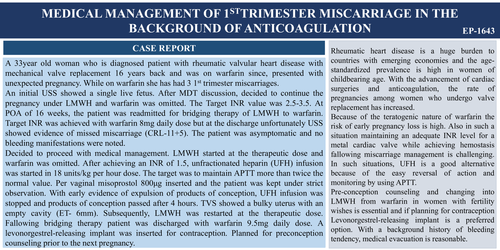
A 33year old woman who is diagnosed patient with rheumatic valvular heart disease presented a fallowing positive urine hCG test. She has undergone mitral valve (mechanical valve) replacement 16 years back and was on warfarin since. She has had 3 first trimester miscarriages which were conceived while on warfarin.
An initial USS showed a single live fetus (CRL-7+1). The pregnancy was continued under low molecular weight heparin (LMWH) and warfarin was omitted. The Target INR value was 2.5-3.5. At POA of 16 weeks, the patient was readmitted for bridging therapy of LMWH to warfarin. Target INR was achieved with warfarin 8mg daily dose but at the discharge unfortunately USS showed evidence of missed miscarriage (CRL-11+5). The patient was asymptomatic and no bleeding manifestations were noted.
Decided to proceed with medical management. LMWH started at the therapeutic dose and warfarin was omitted. After achieving an INR of 1.5, unfractionated heparin (UFH) infusion was started in 18 units/kg per hour dose. The target was to maintain APTT more than twice the normal value. Per vaginal misoprostol 800μg inserted and the patient was kept under strict observation. With early evidence of expulsion of products of conception, UFH infusion was stopped and products of conception passed after 4 hours. TVS showed a bulky uterus with an empty cavity (ET- 6mm). Subsequently, LMWH was restarted at the therapeutic dose. Fallowing bridging therapy patient was discharged with warfarin 9.5mg daily dose. A levonorgestrel-releasing implant was inserted for contraception. Planned for preconception counseling prior to the next pregnancy.
Discussion
Because of the teratogenic nature of warfarin the risk of early pregnancy loss is high. Also in such a situation maintaining an adequate INR level for a metal cardiac valve while achieving hemostasis is challenging. In such situations, UFH is a good alternative because of the easy reversal of action and monitoring by using APTT.
Conclusions
Pre-conception counseling and changing into LMWH from warfarin in women with fertility wishes is essential and if planning for contraception Levonorgestrel-releasing implant is a preferred option. With a background history of bleeding tendency, medical evacuation is a reasonable option.