1,830 posters, 67 videos, 75 audios, 29 topics, 22 sessions, 4,727 authors, 1,697 institutions
ePostersLive by SciGen Technologies S.A. All rights reserved.
RCOG World Congress 2023
June 12 - 14, 2023 | London, UK

EP.1042
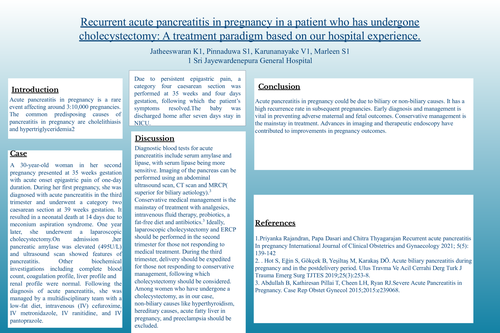
Recurrent acute pancreatitis in pregnancy in a patient who has undergone cholecystectomy
Part of Topic
Imaging in Obstetrics
Recurrent acute pancreatitis in pregnancy in a patient who has undergone
cholecystectomy: A treatment paradigm based on our hospital experience.
Jatheeswaran K1, Pinnaduwa S1, Karunanayake V1, Marleen S1
1 Sri Jayewardenepura General Hospital
Case
A 30-year-old woman in her second
pregnancy presented at 35 weeks gestation
with acute onset epigastric pain of one-day
duration. During her first pregnancy, she was
diagnosed with acute pancreatitis in the third
trimester and underwent a category two
caesarean section at 39 weeks gestation. It
resulted in a neonatal death at 14 days due to
meconium aspiration syndrome. One year
later, she underwent a laparoscopic
cholecystectomy.On admission ,her
pancreatic amylase was elevated (495U/L)
and ultrasound scan showed features of
pancreatitis. Other biochemical
investigations including complete blood
count, coagulation profile, liver profile and
renal profile were normal. Following the
diagnosis of acute pancreatitis, she was
managed by a multidisciplinary team with a
low-fat diet, intravenous (IV) cefuroxime,
IV metronidazole, IV ranitidine, and IV
pantoprazole.
Due to persistent epigastric pain, a
category four caesarean section was
performed at 35 weeks and four days
gestation, following which the patient’s
symptoms resolved.The baby was
discharged home after seven days stay in
NICU.
Discussion
Diagnostic blood tests for acute
pancreatitis include serum amylase and
lipase, with serum lipase being more
sensitive. Imaging of the pancreas can be
performed using an abdominal
ultrasound scan, CT scan and MRCP(
superior for biliary aetiology).3
Conservative medical management is the
mainstay of treatment with analgesics,
intravenous fluid therapy, probiotics, a
fat-free diet and antibiotics.3 Ideally,
laparoscopic cholecystectomy and ERCP
should be performed in the second
trimester for those not responding to
medical treatment. During the third
trimester, delivery should be expedited
for those not responding to conservative
management, following which
cholecystectomy should be considered.
Among women who have undergone a
cholecystectomy, as in our case,
non-biliary causes like hyperthyroidism,
hereditary causes, acute fatty liver in
pregnancy, and preeclampsia should be
excluded.
Conclusion
Acute pancreatitis in pregnancy could be due to biliary or non-biliary causes. It has a
high recurrence rate in subsequent pregnancies. Early diagnosis and management is
vital in preventing adverse maternal and fetal outcomes. Conservative management is
the mainstay in treatment. Advances in imaging and therapeutic endoscopy have
contributed to improvements in pregnancy outcomes.
References
1.Priyanka Rajandran, Papa Dasari and Chitra Thyagarajan Recurrent acute pancreatitis
In pregnancy International Journal of Clinical Obstetrics and Gynaecology 2021; 5(5):
139-142
2. . Hot S, Eğin S, Gökçek B, Yeşiltaş M, Karakaş DÖ. Acute biliary pancreatitis during
pregnancy and in the postdelivery period. Ulus Travma Ve Acil Cerrahi Derg Turk J
Trauma Emerg Surg TJTES 2019;25(3):253-8.
3. Abdullah B, Kathiresan Pillai T, Cheen LH, Ryan RJ.Severe Acute Pancreatitis in
Pregnancy. Case Rep Obstet Gynecol 2015;2015:e239068.