296 posters, 7 videos, 13 audios, 14 topics, 10 sessions, 1,019 authors, 260 institutions
ePostersLive by SciGen Technologies S.A. All rights reserved.
RCOphth Annual Congress 2026
18 - 21 May, 2026 | Manchester Central, Manchester

P064
Biomechanical�and structural�comparison of lenticule addition procedures (LIKE,�sLIKE�and delamination)�for the treatment of�keratoconus and refractive error
Poster Presenter
Part of Topic
Cataract and refractive surgery
Audio
Biomechanical and structural comparison of lenticule addition procedures (LIKE, sLIKE and delamination) for the treatment of keratoconus and refractive errors
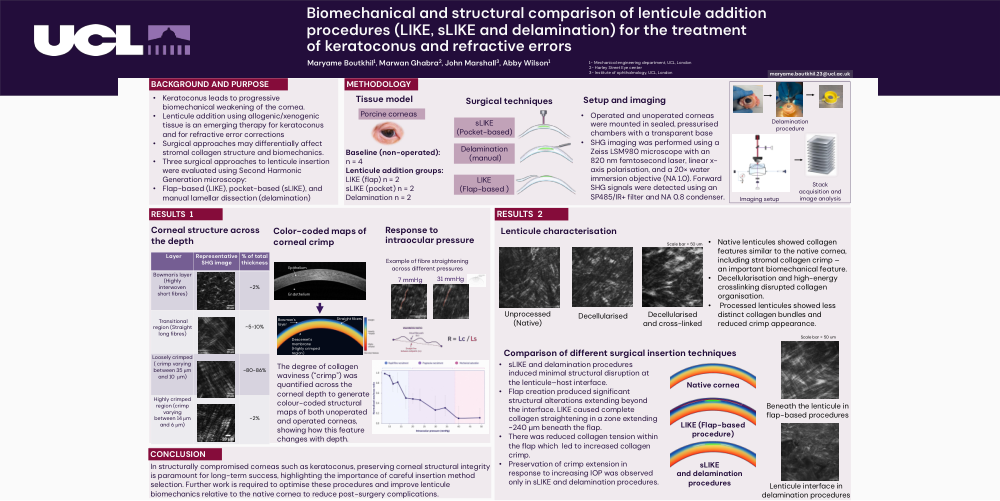
Purpose: Allogenic and xenogenic tissue-based lenticules are increasingly being used to treat keratoconus and are now being explored as alternatives to refractive laser surgery. Hence, it is important to understand how their insertion influences outcomes both optically, in achieving a good refractive result, and biomechanically, in avoiding corneal melt, and stabilising biomechanical weakening in keratoconic corneas. Here, we compare the structural properties of crosslinked lenticules (Xenia) with native tissue, and evaluate how different insertion approaches (flap-based LIKE, pocket-based sLIKE, and delamination) modify corneal structure and biomechanics.
Methods: Using Second Harmonic Generation (SHG) Microscopy, non-operated porcine corneas (n=4) were evaluated under physiological pressures establishing a baseline of stromal collagen structure in relation to depth. Xenia lenticules were inserted into porcine corneas via three different insertion procedures: flap-based Lenticule Intrastromal Keratoplasty (LIKE) (n =2), pocket-based small-incision Lenticule Intrastromal Keratoplasty (sLIKE) (n=2), and a manual procedure (delamination ) (n=2), after which corneas were evaluated via SHG to quantify changes to structure and biomechanics.
Results: Corneas show a distinct depth-dependent structure closely related to spatial biomechanical properties. From a depth of 110um below the anterior surface, a proportion of the stromal collagen was wavy ‘crimped’ under normal physiological pressures. The presence of waviness became more predominant with depth being most pronounced near
Conclusions: In already structurally compromised corneas such as those of Keratoconus patients, preserving and improving the structural integrity of the cornea is paramount to the long-term success of the procedure so significant care should be taken when selecting the insertion method. Further work is required to futher optimise these procedures and optimise the biomechanical properties of the lenticules relative to the native cornea to reduce the risk of post-surgery complications.
the endothelium. Under increasing pressure, a gradual- nonlinear straightening of the crimped fibers was evident demonstrating the role of this structural mechanism in accomodating for IOP changes. Both sLIKE and delamination procedures induced minimal structural disruptions at the lenticule - host interface. In contrast, creation of a flap produced significant structural alterations extending well beyond the interface, including complete straightening of the collagen in a zone extending 240um beneath the flap and a reduction in tension of the collagen in the flap leading to increased crimp. The extension of crimp in response to IOP increases, was preserved throughout the depth in both sLIKE and delamination only.