296 posters, 7 videos, 13 audios, 14 topics, 10 sessions, 1,019 authors, 259 institutions
ePostersLive by SciGen Technologies S.A. All rights reserved.
RCOphth Annual Congress 2026
18 - 21 May, 2026 | Manchester Central, Manchester

P062
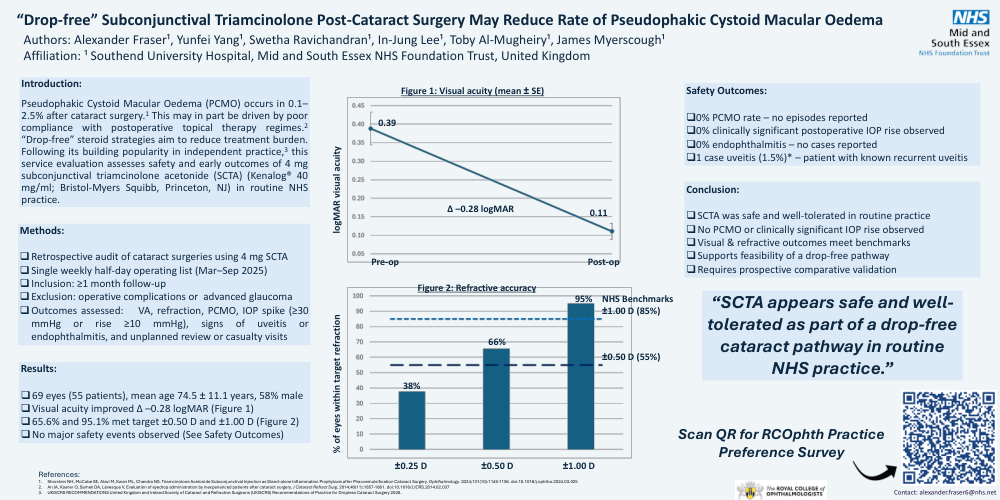
�Drop-free� Subconjunctival Triamcinolone Post-Cataract Surgery May Reduce Rate of Pseudophakic Cystoid Macular Oedema
Poster Presenter
Part of Topic
Cataract and refractive surgery
“Drop-free” Subconjunctival Triamcinolone Post-Cataract Surgery May Reduce Rate of Pseudophakic Cystoid Macular Oedema
Authors: Alexander Fraser¹, Yunfei Yang¹, Swetha Ravichandran¹, In-Jung Lee¹, Toby Al-Mugheiry¹, James Myerscough¹
Affiliation: ¹ Southend University Hospital, Mid and South Essex NHS Foundation Trust, United Kingdom
Introduction:
Pseudophakic Cystoid Macular Oedema (PCMO) occurs in 0.1–2.5% after cataract surgery.1 This may in part be driven by poor compliance with postoperative topical therapy regimes.2 “Drop-free” steroid strategies aim to reduce treatment burden. Following its building popularity in independent practice,3 this service evaluation assesses safety and early outcomes of 4 mg subconjunctival triamcinolone acetonide (SCTA) (Kenalog® 40 mg/ml; Bristol-Myers Squibb, Princeton, NJ) in routine NHS practice.
Methods:
Results:
Safety Outcomes:
Conclusion:
“SCTA appears safe and well-tolerated as part of a drop-free cataract pathway in routine NHS practice.”
References:
1. Shorstein NH, McCabe SE, Alavi M, Kwan ML, Chandra NS. Triamcinolone Acetonide Subconjunctival Injection as Stand-alone Inflammation Prophylaxis after Phacoemulsification Cataract Surgery. Ophthalmology. 2024;131(10):1145-1156. doi:10.1016/j.ophtha.2024.03.025
2. An JA, Kasner O, Samek DA, Lévesque V. Evaluation of eyedrop administration by inexperienced patients after cataract surgery. J Cataract Refract Surg. 2014;40(11):1857-1861. doi:10.1016/J.JCRS.2014.02.037
3. UKISCRS RECOMMENDATIONS United Kingdom and Ireland Society of Cataract and Refractive Surgeons (UKISCRS) Recommendations of Practice for Dropless Cataract Surgery 2026.
Link to practice preference survey: https://forms.gle/CvFtwHw8K6VtT1r39