296 posters, 7 videos, 13 audios, 14 topics, 10 sessions, 1,019 authors, 259 institutions
ePostersLive by SciGen Technologies S.A. All rights reserved.
RCOphth Annual Congress 2026
18 - 21 May, 2026 | Manchester Central, Manchester

P068
Developing Training the Trainers for Independent Sector Trainers and Cataract Surgeons at The Royal College of Ophthalmology
Poster Presenter
Authors
Part of Topic
Cataract and refractive surgery
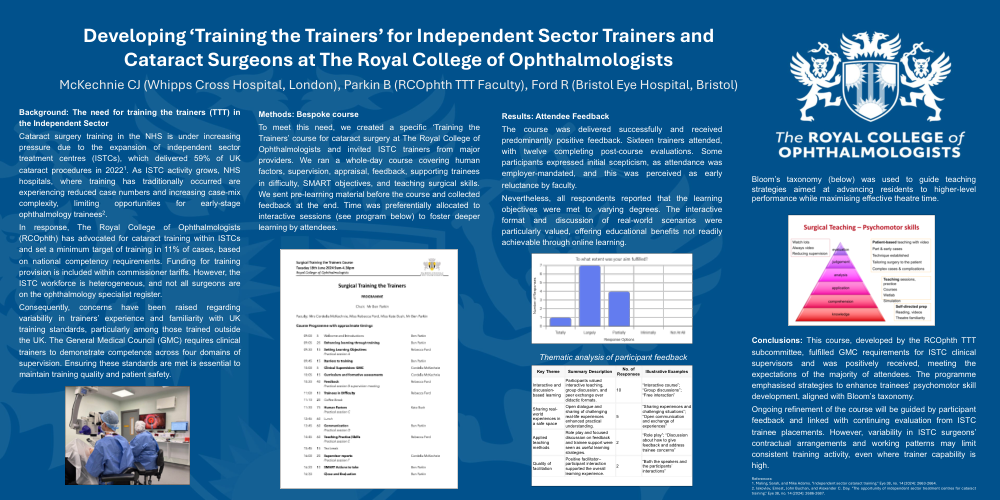
Developing ‘Training the Trainers’ for Independent Sector Trainers and Cataract Surgeons at The Royal College of Ophthalmologists
McKechnie CJ (Whipps Cross Hospital, London), Parkin B (RCOphth TTT Faculty), Ford R (Bristol Eye Hospital, Bristol)
Background: The need for training the trainers (TTT) in the Independent Sector
Cataract surgery training in the NHS is under increasing pressure due to the expansion of independent sector treatment centres (ISTCs), which delivered 59% of UK cataract procedures in 2022. As ISTC activity grows, NHS hospitals, where training has traditionally occurred are experiencing reduced case numbers and increasing case‑mix complexity, limiting opportunities for early‑stage ophthalmology trainees.
In response, The Royal College of Ophthalmologists (RCOphth) has advocated for cataract training within ISTCs and set a minimum target of training in 11% of cases, based on national competency requirements. Funding for training provision is included within commissioner tariffs. However, the ISTC workforce is heterogeneous, and not all surgeons are on the ophthalmology specialist register.
Consequently, concerns have been raised regarding variability in trainers’ experience and familiarity with UK training standards, particularly among those trained outside the UK. The General Medical Council (GMC) requires clinical trainers to demonstrate competence across four domains of supervision. Ensuring these standards are met is essential to maintain training quality and patient safety.
Methods: Bespoke course
To meet this need, we created a specific ‘Training the Trainers’ course for cataract surgery at The Royal College of Ophthalmologists and invited ISTC trainers from major providers. We ran a whole-day course covering human factors, supervision, appraisal, feedback, supporting trainees in difficulty, SMART objectives, and teaching surgical skills. We sent pre-learning material before the course and collected feedback at the end. Time was preferentially allocated to interactive sessions (see program below) to foster deeper learning by attendees.
Results: Attendee Feedback
The course was delivered successfully and received predominantly positive feedback. Sixteen trainers attended, with twelve completing post‑course evaluations. Some participants expressed initial scepticism, as attendance was employer‑mandated, and this was perceived as early reluctance by faculty.
Nevertheless, all respondents reported that the learning objectives were met to varying degrees. The interactive format and discussion of real‑world scenarios were particularly valued, offering educational benefits not readily achievable through online learning.
Bloom’s taxonomy was used to guide teaching strategies aimed at advancing residents to higher-level performance while maximising effective theatre time.
Conclusions: This course, developed by the RCOphth TTT subcommittee, fulfilled GMC requirements for ISTC clinical supervisors and was positively received, meeting the expectations of the majority of attendees. The programme emphasised strategies to enhance trainees’ psychomotor skill development, aligned with Bloom’s taxonomy.
Ongoing refinement of the course will be guided by participant feedback and linked with continuing evaluation from ISTC trainee placements. However, variability in ISTC surgeons’ contractual arrangements and working patterns may limit consistent training activity, even where trainer capability is high.
References:
1. Maling, Sarah, and Mike Adams. "Independent sector cataract training." Eye 38, no. 14 (2024): 2663-2664.
2. Iakovlev, Ernest, John Buchan, and Alexander C. Day. "The opportunity of independent sector treatment centres for cataract training." Eye 38, no. 14 (2024): 2686-2687.