296 posters, 7 videos, 13 audios, 14 topics, 10 sessions, 1,019 authors, 259 institutions
ePostersLive by SciGen Technologies S.A. All rights reserved.
RCOphth Annual Congress 2026
18 - 21 May, 2026 | Manchester Central, Manchester

P242
THRIVE Phase 3 Trial of Veligrotug in Active Thyroid Eye Disease (TED): Efficacy, Safety, and Quality of Life at 15 Weeks
Poster Presenter
Authors
Vickie Lee, Antonio Manuel Garrido-Hermosilla, Peerooz Saeed, Michael Schittkowski, Ashley Pajak, Abhijit Narvekar
Affiliations
Imperial College Healthcare NHS Trust - Western Eye Hospital, London, UK, Hospital Universitario Virgen Macarena, Universidad de Sevilla, Seville, Spain, Amsterdam UMC location AMC, Amsterdam, the Netherlands, Universitätsmedizin Göttingen, Göttingen, Germany, Viridian Therapeutics, Inc., Waltham, MA, USA
Part of Topic
Neuro ophthalmology
Title: THRIVE Phase 3 Trial of Veligrotug in Active Thyroid Eye Disease (TED): Efficacy, Safety, and Quality of Life at 15 Weeks
Purpose:
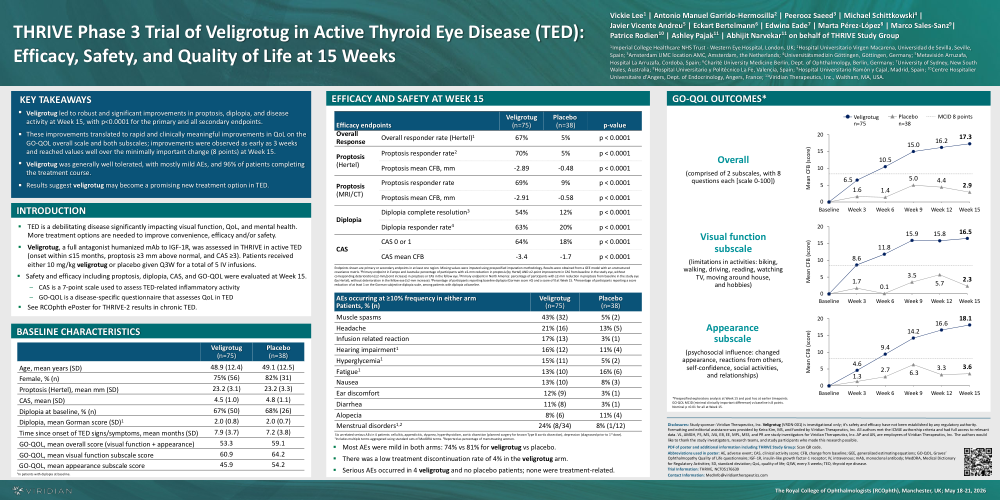
Thyroid eye disease (TED) is a debilitating autoimmune condition that not only impairs visual function but also significantly affects daily life. Veligrotug, a full antagonist humanized monoclonal antibody targeting the IGF-1 receptor, is being evaluated for TED. Here, we report efficacy, safety, and Graves Ophthalmopathy Quality of Life (GO-QOL) outcomes from the phase 3 THRIVE randomized controlled trial of veligrotug in active TED (NCT05176639).
Methods:
Adults with moderate-to-severe active TED (onset ≤15 months, proptosis ≥3 mm above normal, and clinical activity score [CAS] ≥3) were randomized to receive 10 mg/kg veligrotug or placebo, each administered once every 3 weeks for a total of 5 IV infusions. Efficacy, treatment-emergent adverse events (AEs), and mean change from baseline (CFB) in GO-QOL scores (exploratory endpoint) were assessed through Week 15.
Results:
A total of 113 patients received veligrotug (n=75) or placebo (n=38). Veligrotug resulted in improvements in TED signs/symptoms as early as Week 3, with statistically significant improvements vs placebo at Week 15 for all primary and secondary outcomes (p<0.0001 for all) including: overall responder rate by Hertel (67% vs 5%), proptosis responder rate by Hertel (70% vs 5%), mean CAS reduction (3.4 vs 1.7), diplopia response (63% vs 20%), and diplopia resolution (54% vs 12%). These significant improvements translated into rapid and clinically meaningful improvements in GO-QOL, exceeding the minimal clinically important difference (8 points) over baseline at Week 15 for veligrotug vs placebo. The GO-QOL overall score mean CFB was 17.3 vs 2.9, with 16.5 vs 2.3 for the visual functioning subscale and 18.1 vs 3.6 for the appearance subscale (nominal p<0.001 for all). Most AEs were mild and there were no treatment-related serious AEs.
Conclusions:
Veligrotug was generally well tolerated and led to rapid and statistically significant improvements in proptosis, CAS, and diplopia, and clinically meaningful improvement in quality-of-life outcomes in patients with active TED. A 12-week, 5-infusion treatment regimen of veligrotug may become a potential treatment option for TED.