296 posters, 7 videos, 13 audios, 14 topics, 10 sessions, 1,019 authors, 259 institutions
ePostersLive by SciGen Technologies S.A. All rights reserved.
RCOphth Annual Congress 2026
18 - 21 May, 2026 | Manchester Central, Manchester

P238
Global Optic Neuritis Practice Patterns and Health System Resource Survey Explores Factors Impacting Outcomes
Poster Presenter
Authors
Cara Heppell, Manik Sharma, Anushka Irodi, K.D. Frick, Clare Fraser, Olufunmilola Ogun, Axel Petzold, Tasanee Braithwaite
Affiliations
Faculty of Life Science and Medicine, King's College London, London, UK, School of Clinical Medicine, University of Cambridge, UK, Johns Hopkins Carey Business School, USA, Sydney Eye Hospital, Australia, University of Ibadan, Nigeria, Institute of Neurology, University College London, London, UK; National Hospital for Neurology and Neurosurgery, London, UK; Moorfields Eye Hospital NHS Foundation Trust, London, UK, Faculty of Life Science and Medicine, King's College London, London, UK; Centre for Translational Medicine, King’s Health Partners, London, UK; The Medical Eye Unit, Guy’s and St Thomas’ NHS Foundation Trust
Part of Topic
Neuro ophthalmology
Introduction
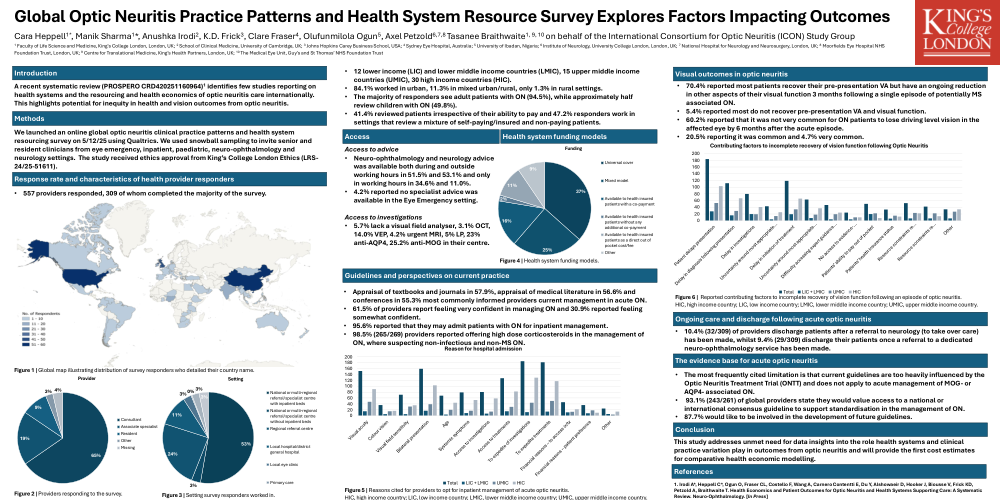
A recent systematic review (PROSPERO CRD420251160964)1 identifies few studies reporting on health systems and the resourcing and health economics of optic neuritis care internationally. This highlights potential for inequity in health and vision outcomes from optic neuritis.
Methods
We launched an online global optic neuritis clinical practice patterns and health system resourcing survey on 5/12/25 using Qualtrics. We used snowball sampling to invite senior and resident clinicians from eye emergency, inpatient, paediatric, neuro-ophthalmology and neurology settings. The study received ethics approval from King’s College London Ethics (LRS-24/25-51611).
Response rate and characteristics of health provider responders
Figure 2 | Providers responding to the survey.
Figure 3 | Setting survey responders worked in.
Access
Access to advice
Access to investigations
Health system funding models
Figure 4 | Health system funding models
Guidelines and perspectives on current practice
Figure 5 | Reasons cited for providers to opt for inpatient management of acute optic neuritis.
HIC, high income country; LIC, low income country; LMIC, lower middle income country; UMIC, upper middle incomecountryVisual outcomes in optic neuritis
Figure 6 | Reported contributing factors to incomplete recovery of vision function following an episode of optic neuritis.
HIC, high income country; LIC, low income country; LMIC, lower middle income country; UMIC, upper middle incomecountry.
Ongoing care and discharge following acute optic neuritis
This study addresses unmet need for data insights into the role health systems and clinical practice variation play in outcomes from optic neuritis and will provide the first cost estimates for comparative health economic modelling.