358 posters, 97 topics, 122 sessions, 958 authors, 239 institutions
ePostersLive by SciGen Technologies S.A. All rights reserved.
79th PostGraduate Assembly in Anesthesiology 2025
December 12 - 15, 2025 | New York City

2127
Cesarean delivery in a patient with Fabry Disease- Anesthetic Implications
Poster Presenter
Authors
Affiliations
Part of Topic
Obstetrics
●Fabry disease is a multisystemic X-linked lysosomal storage disorder characterized by decreased alpha-galactosidase A activity causing glycosphingolipid accumulation that causes multisystem organ dysfunction1,2,3.
●This can have implications for the care of parturients.
●A 32 weeks gestation patient, G3P2012 with history of Fabry disease presented with headaches and dizziness.
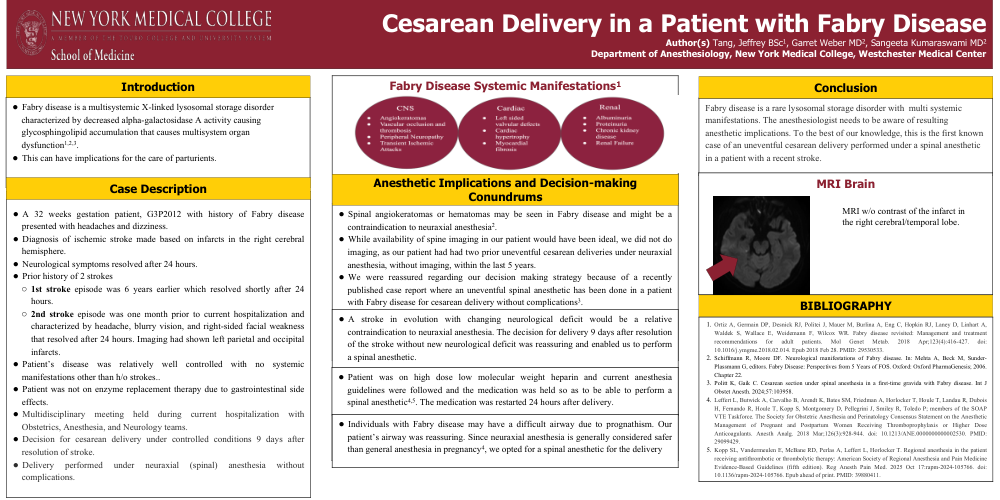
●Diagnosis of ischemic stroke made based on infarcts in the right cerebral hemisphere.
●Neurological symptoms resolved after 24 hours.
●Prior history of 2 strokes
○1st stroke episode was 6 years earlier which resolved shortly after 24 hours.
○2nd stroke episode was one month prior to current hospitalization and characterized by headache, blurry vision, and right-sided facial weakness that resolved after 24 hours. Imaging had shown left parietal and occipital infarcts.
●Patient’s disease was relatively well controlled with no systemic manifestations other than h/o strokes..
●Patient was not on enzyme replacement therapy due to gastrointestinal side effects.
●Multidisciplinary meeting held during current hospitalization with Obstetrics, Anesthesia, and Neurology teams.
●Decision for cesarean delivery under controlled conditions 9 days after resolution of stroke.
●Delivery performed under neuraxial (spinal) anesthesia without complications.
●Spinal angiokeratomas or hematomas may be seen in Fabry disease and might be a contraindication to neuraxial anesthesia2.
●While availability of spine imaging in our patient would have been ideal, we did not do imaging, as our patient had had two prior uneventful cesarean deliveries under neuraxial anesthesia, without imaging, within the last 5 years.
●We were reassured regarding our decision making strategy because of a recently published case report where an uneventful spinal anesthetic has been done in a patient with Fabry disease for cesarean delivery without complications3.
●A stroke in evolution with changing neurological deficit would be a relative contraindication to neuraxial anesthesia. The decision for delivery 9 days after resolution of the stroke without new neurological deficit was reassuring and enabled us to perform a spinal anesthetic.
●Patient was on high dose low molecular weight heparin and current anesthesia guidelines were followed and the medication was held so as tobe able to perform a spinal anesthetic4,5. The medication was restarted 24 hours after delivery.
●Individuals with Fabry disease may have a difficult airway due to prognathism. Our patient’s airway was reassuring. Since neuraxial anesthesia is generally considered safer than general anesthesia in pregnancy4, we opted for a spinal anesthetic for the delivery
Fabry disease is a rare lysosomal storage disorder with multi systemic manifestations. The anesthesiologist needs to be aware of resulting anesthetic implications. To the best of our knowledge, this is the first known case of an uneventful cesarean delivery performed under a spinal anesthetic in a patient with a recent stroke.