358 posters, 97 topics, 122 sessions, 958 authors, 239 institutions
ePostersLive by SciGen Technologies S.A. All rights reserved.
79th PostGraduate Assembly in Anesthesiology 2025
December 12 - 15, 2025 | New York City

2016
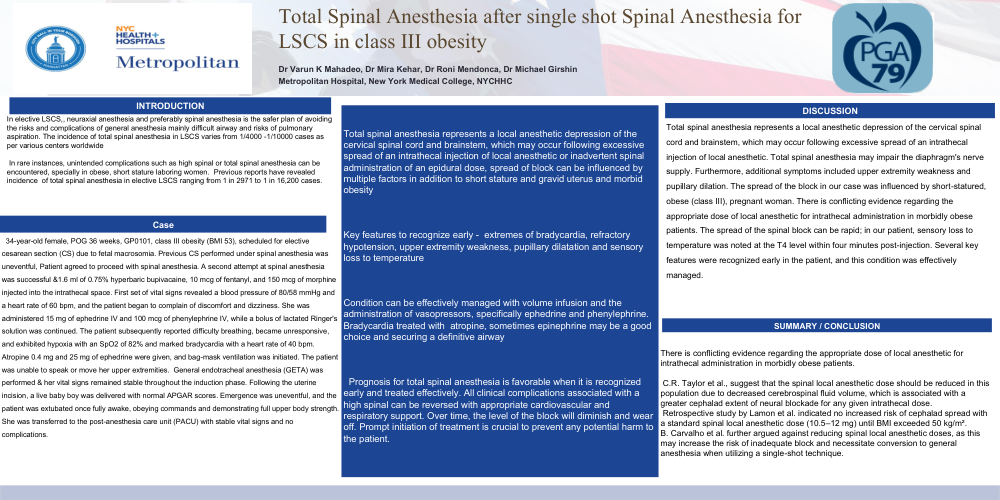
Total Spinal Anesthesia after single shot Spinal for LSCS in Class III Obesity
Poster Presenter
Part of Topic
Obstetrics
In elective LSCS,, neuraxial anesthesia and preferably spinal anesthesia is the safer plan of avoiding the risks and complications of general anesthesia mainly difficult airway and risks of pulmonary aspiration. The incidence of total spinal anesthesia in LSCS varies from 1/4000 -1/10000 cases as per various centers worldwide
In rare instances, unintended complications such as high spinal or total spinal anesthesia can be encountered, specially in obese, short stature laboring women. Previous reports have revealed incidence of total spinal anesthesia in elective LSCS ranging from 1 in 2971 to 1 in 16,200 cases.
34-year-old female, POG 36 weeks, GP0101, class III obesity (BMI 53), scheduled for elective cesarean section (CS) due to fetal macrosomia. Previous CS performed under spinal anesthesia was uneventful, Patient agreed to proceed with spinal anesthesia. A second attempt at spinal anesthesia was successful &1.6 ml of 0.75% hyperbaric bupivacaine, 10 mcg of fentanyl, and 150 mcg of morphine injected into the intrathecal space. First set of vital signs revealed a blood pressure of 80/58 mmHg and a heart rate of 60 bpm, and the patient began to complain of discomfort and dizziness. She was administered 15 mg of ephedrine IV and 100 mcg of phenylephrine IV, while a bolus of lactated Ringer's solution was continued. The patient subsequently reported difficulty breathing, became unresponsive, and exhibited hypoxia with an SpO2 of 82% and marked bradycardia with a heart rate of 40 bpm. Atropine 0.4 mg and 25 mg of ephedrine were given, and bag-mask ventilation was initiated. The patient was unable to speak or move her upper extremities. General endotracheal anesthesia (GETA) was performed & her vital signs remained stable throughout the induction phase. Following the uterine incision, a live baby boy was delivered with normal APGAR scores. Emergence was uneventful, and the patient was extubated once fully awake, obeying commands and demonstrating full upper body strength. She was transferred to the post-anesthesia care unit (PACU) with stable vital signs and no complications
Total spinal anesthesia represents a local anesthetic depression of the cervical spinal cord and brainstem, which may occur following excessive spread of an intrathecal injection of local anesthetic. Total spinal anesthesia may impair the diaphragm's nerve supply. Furthermore, additional symptoms included upper extremity weakness and pupillary dilation. The spread of the block in our case was influenced by short-statured, obese (class III), pregnant woman. There is conflicting evidence regarding the appropriate dose of local anesthetic for intrathecal administration in morbidly obese patients. The spread of the spinal block can be rapid; in our patient, sensory loss to temperature was noted at the T4 level within four minutes post-injection. Several key features were recognized early in the patient, and this condition was effectively managed.
There is conflicting evidence regarding the appropriate dose of local anesthetic for intrathecal administration in morbidly obese patients.
C.R. Taylor et al., suggest that the spinal local anesthetic dose should be reduced in this population due to decreased cerebrospinal fluid volume, which is associated with a greater cephalad extent of neural blockade for any given intrathecal dose.
Retrospective study by Lamon et al. indicated no increased risk of cephalad spread with a standard spinal local anesthetic dose (10.5–12 mg) until BMI exceeded 50 kg/m².
B. Carvalho et al. further argued against reducing spinal local anesthetic doses, as this may increase the risk of inadequate block and necessitate conversion to general anesthesia when utilizing a single-shot techn