358 posters, 97 topics, 122 sessions, 958 authors, 239 institutions
ePostersLive by SciGen Technologies S.A. All rights reserved.
79th PostGraduate Assembly in Anesthesiology 2025
December 12 - 15, 2025 | New York City

2014
Demyelination and Dural Risks: The Impact of PLEX and Coagulopathy on Neuraxial Anesthesia in Multiple Sclerosis
Poster Presenter
Authors
Affiliations
Part of Topic
Obstetrics
Learning objective: To review the anesthetic considerations and optimization of the partiurient in the setting of relapsing remitting multiple sclerosis undergoing plasmapheresis sessions with abnormal coagulation studies. (21/30)
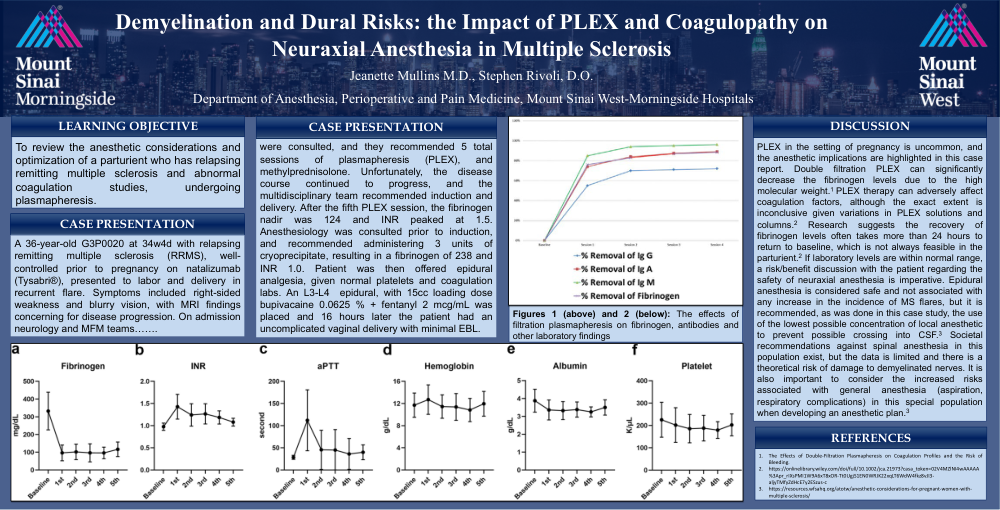
Case Description: A 36-year-old G3P0020 at 34w4d with relapsing remitting multiple sclerosis (RRMS), well-controlled prior to pregnancy on Tysabri, presented to labor and delivery in recurrent flare. Symptoms included right-sided weakness and blurry vision, with MRI concerning disease progression. On admission neurology and MFM teams consulted who recommended five total sessions of plasmapheresis, and methylprednisolone. Unfortunately, the disease course continued to progress, and the multidisciplinary team recommended induction and delivery. After the fifth PLEX session, the fibrinogen nadir was 124 and INR peaked at 1.5. Anesthesiology was consulted prior to induction, and recommended administering 3 units of cryoprecipitate, resulting in a fibrinogen of 238 and INR 1.0. Patient was then offered epidural analgesia, given normal platelets and coagulation labs. An L3-L4 epidural, with 15cc loading dose bupivacaine 0.0625 % + fentanyl 2 mcg/mL was placed and 16 hours later patient had an uncomplicated vaginal delivery with minimal EBL. (148/150 words)
Discussion: Plasmapheresis (PLEX) in the setting of pregnancy is uncommon, and the anesthetic implications are highlighted in this case report. Double filtration PLEX can significantly decrease the fibrinogen levels due to the high molecular weight(1). PLEX therapy can adversely affect coagulation factors, although the exact extent is inconclusive given variations in PLEX solutions and columns (2). Research suggests the recovery of fibrinogen levels often takes more than 24 hours to return to baseline, which is not always feasible in the parturient(2). If laboratory levels are within normal range, a risk/benefit discussion with the patient regarding the safety of neuraxial anesthesia is imperative. Epidural anesthesia is considered safe and not associated with any increase in the incidence of MS flares, but it is recommended, as was done in this case study, the use of the lowest possible concentration of local anesthetic in order to prevent possible crossing into CSF (3). Societal recommendations against spinal anesthesia in this population as the data is limited and there is a theoretical risk of damage to demyelinated nerves. It is also important to consider the increased risks associated with general anesthesia (aspiration, respiratory complications) in this special population when considering an anesthetic plan(3). (239 words)
References:
- The Effects of Double-Filtration Plasmapheresis on Coagulation Profiles and the Risk of Bleeding.
- https://onlinelibrary.wiley.com/doi/full/10.1002/jca.21973?casa_token=02V4MZlNI4wAAAAA%3Apr_rIXsPMI1W9A6xT8xOR-Tt0UgjS1EN0WRJK22xqLT6WdW4fkz8vJI3-aljyTMfyZdHcE7y2ESzus-c
- https://resources.wfsahq.org/atotw/anesthetic-considerations-for-pregnant-women-with-multiple-sclerosis/